
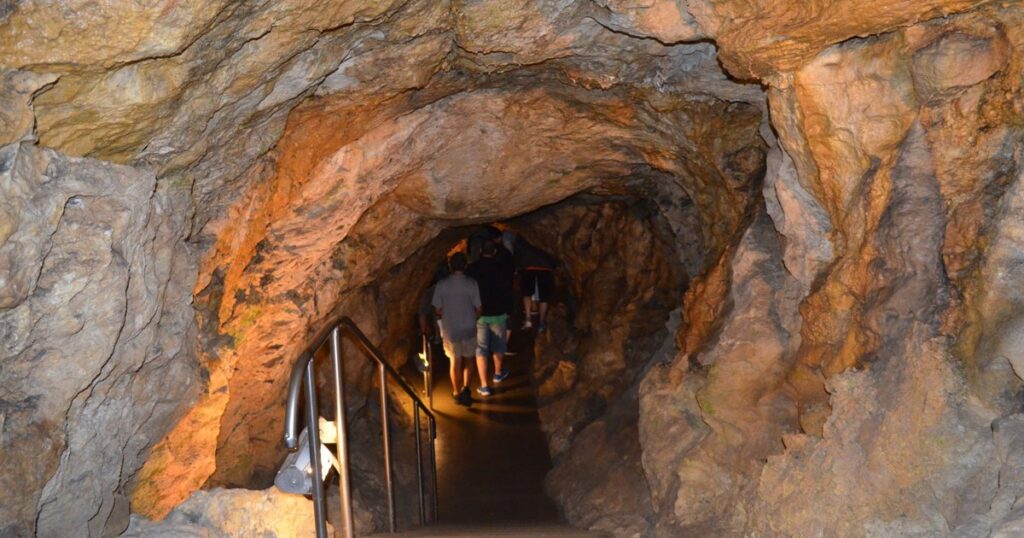
Pálvölgyi Cave Budapest
Pálvölgyi Cave Budapest Tour Beneath the Buda Hills
Our Pálvölgyi Cave Budapest visit started with a taxi ride, not a tram. We couldn't find an easy transit route from our hotel, so we hailed a cab. The driver climbed into the leafy Buda Hills, past villas and garden walls. Finally, he stopped beside a modest entrance on Szépvölgyi út. Without him, we might have driven straight past it.
Pálvölgyi Cave Budapest Begins in a Brick Passage with a Plaque for Lóczy Lajos
Inside, the air turned cool at once. The cave stays at 11°C all year, so bring a sweater even in summer. Before we reached any real rock, we walked through a brick-lined passage. A marble plaque hangs on one wall there. It honours Dr. Lóczy Lajos, a celebrated Hungarian geographer and geologist. The Pannonia Tourist Association's caving section put it up in October 1920. Later, in 2001, a new generation restored it. In other words, people have cared about this place for more than a century.

The 1920 marble plaque honouring geologist Lóczy Lajos, restored in 2001.
How a Lost Sheep Found a Cave
The cave's own story starts with an accident. According to local legend, a sheep vanished into a hole near a quarry in July 1904. When locals went looking for it, they found a cave instead. By 1919, the first visitors were walking these passages. Today, the connected system ranks as the longest cave in Hungary.
Cave Passages Feel Like Canyons
Once the brick ended, the real cave began. The passages here aren't wide halls. Instead, they rise as tall, narrow cracks, as if someone split the hill with an axe. Lamps on the walls throw amber light up the stone. Above us, the ceiling leaned in huge tilted slabs. Our group pressed together and craned our necks to look up. Meanwhile, our guide explained how warm, mineral-rich water carved these channels from below.

Our tour group gathers beneath a huge tilted slab of limestone.
Dripstone That Looks Like Melted Wax
In some spots, the walls look melted. One ledge drips with flowstone like candle wax frozen mid-pour. Below it hangs a fringe of orange and cream stalactites. Up close, the hill seems to be slowly turning itself into lace. These dripstones made the cave famous, and they earn the fame.

Orange and cream stalactites hang like melted wax from a flowstone ledge.
Pálvölgyi Cave Budapest Has Squeezes and a Ladder
Next came the squeeze. A slot opened in the rock, just wide enough for one person turned sideways. The youngest explorer in our group went first, flashlight in one hand and handout in the other. Every few steps, he popped back into view with a grin. Behind him, the orange glow made the gap look like a secret door. Maybe it was one.

The youngest explorer in our group lights the way through the narrowest squeeze.
Stairs, Ladders and Tilted Ceilings
The route runs about 500 metres, yet it never feels flat. More than 400 steps and a sturdy ladder carry you up and down through the levels. Some ceilings drop low enough that tall visitors duck. For that reason, the cave doesn't suit children under five or anyone with limited mobility. Good shoes help a lot.

Amber light spills through a low passage between the cave's levels.
Remembering Lakatos László
Deeper in, a second plaque stopped us. It remembers Lakatos László, who lived from 1939 to 1970. He explored the Meteor Cave and once worked as a guide here. Sadly, he died in a caving accident during research. He was just 31. Today, a chamber in the cave carries his name. Beneath the plaque, someone had left a wreath of pine and red berries. A ribbon in Hungary's red, white and green held it together. These beautiful passages came at a cost. Somebody had to crawl into the dark first and find them.

A wreath rests beneath the memorial to cave guide Lakatos László.
Pálvölgyi Cave Budapest Ends at a Wishing Pool
Near the end, the passage opened onto a small, still pool. Coins glinted on the bottom, each one a wish from an earlier visitor. Stubby stalagmites stood guard along the edge. Behind the water, a whole wall hung with dripping formations. The surface was so calm that we only saw it where the light hit.

Coins glint at the bottom of the cave's still wishing pool.
After that came the stairs, the railing and the climb back toward daylight. Eventually, we stepped out blinking into an ordinary afternoon. Nobody on the street above could guess what lies beneath them. Water carved it, and brave people mapped it.
Visitor Tips for Your Cave Tour
- Find the entrance at Szépvölgyi út 162 in District II.
- Take a taxi, or ride bus 65 from Kolosy tér to the Pál-völgyi cseppkőbarlang stop.
- Plan for Tuesday to Sunday, because the cave closes on Mondays.
- Expect hourly tours from 10.15 to 16.15, each lasting about an hour.
- Pack a warm layer, since the air stays at 11°C.
- Buy tickets at least 10 minutes before your tour.
- Check current prices on the Duna-Ipoly National Park website
New to the city? Start with our first-timer's guide to Budapest before you head underground.
Explore and Discover







The Travel Tipster
I'm Ed Vasquez — The Travel Tipster. I've explored 35 countries and 100+ cities, almost always in a business class seat earned entirely through points. Firsthand destination guides, honest reviews, and practical points advice — from someone who has actually been there.