

Day Trip to Gripsholm Castle from Stockholm
Day Trip to Gripsholm Castle, From Missed Trains to Sweden's Oldest Portrait Gallery
About an hour outside Stockholm, a day trip to Gripsholm Castle brings you to a red brick castle with copper domes sitting on a spit of land in Lake Mälaren. It has guarded the faces of Swedish royalty for nearly five hundred years. A day trip to Gripsholm gives you a museum where the walls themselves are the exhibit. It also makes an easy add on to your trip to Stockholm.
The Train Mix Up, A Lesson In County Lines

The view from the platform at Södertälje Syd train station.
Other day trips from Stockholm train you into a certain rhythm. You walk up, tap your card, and board. That works fine in Sigtuna, since it sits inside Stockholm County, where the SL ticketing system covers everything.
Gripsholm sits outside that system. We learned this the hard way, boarding with the assumption that we would sort out a ticket along the way, since that had always worked before. About halfway into the ride, though, a conductor stopped us. He explained we had crossed into Södermanland County, then had us get off at Södertälje Syd to buy a proper ticket for the rest of the trip.
Södertälje Syd has no ticket machines or kiosks anywhere on the platform. We stood there stuck until a kind Swedish commuter stepped in. She barely spoke English, yet she still walked us through buying tickets online, both onward to Gripsholm and back again.
If you plan a Stockholm day trip to Gripsholm yourself, buy your train tickets online first. Do not assume your Stockholm transit habits will carry you the whole way once you leave SL territory.
This delay cost us real time. It was our last full day in Stockholm, and we were already running late that Sunday. The detour ate into the afternoon before we had even reached the castle.
The Bus That Would Not Wait
Our return trip taught us the same lesson twice. We were maybe 50 meters from our connecting bus, jogging hard to catch it, and it pulled away without us anyway. Swedish public transport runs precisely on schedule in both directions. It will not wait for latecomers, no matter how close they are.
Between the ticket delay and the missed bus, we ended up with only two hours inside the castle. That was enough to see the highlights, but give yourself more buffer than we did.
Why We Skipped The Ferry for our Day Trip to Gripsholm Castle

The S/S Mariefred, moored near Stockholm City Hall, seen from our room at the Sheraton, the same steamboat that could have carried us to Gripsholm on a 3.5-hour ride each way.
A lovely alternative exists in the historic steamboat S/S Mariefred. It leaves from a dock near many central Stockholm hotels and crosses Lake Mälaren all summer. We considered it, then talked ourselves out of it, and the math explains why.
The ferry ride runs three and a half hours each way. A 10 a.m. departure gets you to the castle in the early afternoon. By the time you are back at your hotel, you have committed roughly ten hours to travel alone. That said, the ride is beautiful and unhurried, and it turns the lake itself into part of the destination.
Still, a full day on the water leaves little room for anything else. Take it if the boat ride is the whole point of your day. Choose the train instead if you want Gripsholm alongside other plans.
Mariefred, The Town Before The Castle
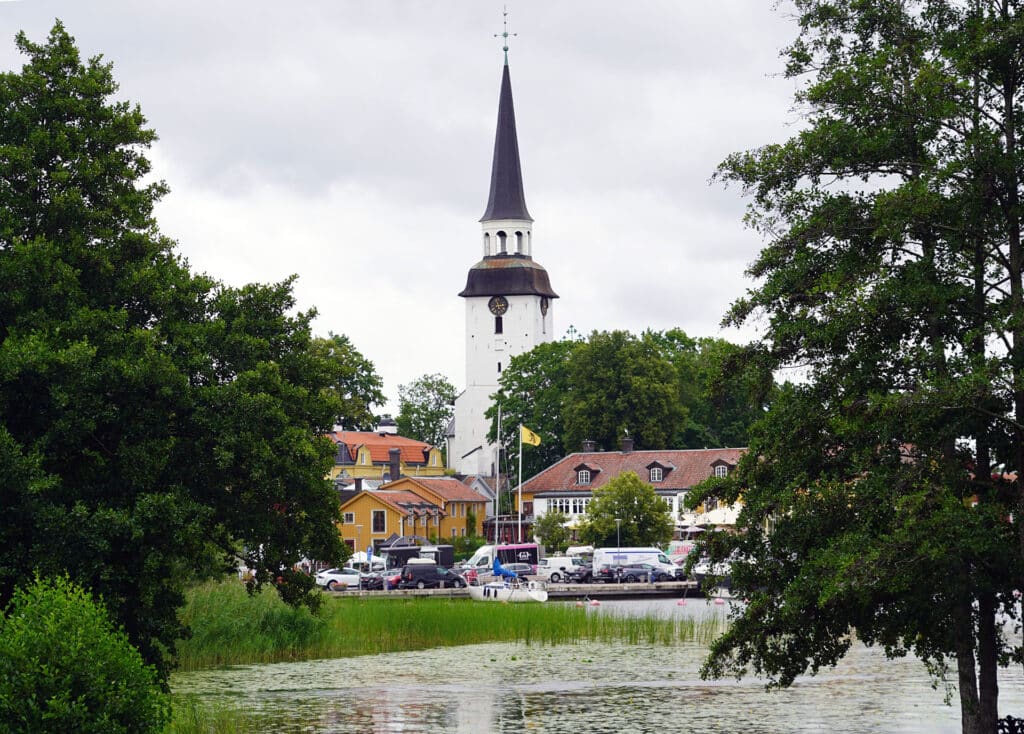
Mariefred's church steeple rising above the harbor.

A welcome map for visitors arriving in Mariefred.
Once you arrive, Mariefred rewards a slow walk. A white church with a black spire watches over rows of yellow wooden houses. Just past the harbor sits a working steam railway museum. Sailboats bob against a backdrop of green hills, and the whole scene practically begs you to grab a coffee and forget the museum entirely.
Keep walking anyway. The castle earns the detour.
Arriving At The Castle

An ornate bronze cannon on display in the castle courtyard.

Cannons positioned inside the castle, aimed toward the water.

A closer look at the castle's defensive armament.
Gripsholm announces itself once you clear the tree line. It is a classic Swedish Vasa era castle, brick red, with round copper domed towers and a moat of lake water on every side. The approach cuts through a wildflower meadow, thick with thistle, yarrow, and waist high clover. Behind it all, the castle's clock tower rises into view. Few approaches are built for a better photograph.
You enter through a grand arched gate under old wooden doors. The original ironwork and hinges still hang in place. Just inside, a pair of cannons sit out in the open courtyard. More surprisingly, another pair waits indoors, aimed out through a stone gun room window toward the water. I would guess those interior cannons covered the approach by boat, a last line of defense against anyone trying to take the castle from the lake. This place was clearly a fortress long before it became a museum.
The National Portrait Gallery

A bronze bust of King Karl XII.

A guided tour moves through one of Gripsholm's portrait rooms.

Four German noblemen painted in a row, part of Gripsholm's international collection.

A grand portrait room at Gripsholm, anchored by a family group painting and an equestrian portrait.
The portrait collection is Gripsholm's real claim to fame. It is worth knowing before your day trip to Gripsholm Castle. The building houses the Swedish National Portrait Gallery, the oldest one in the world, with roots running back to Gustav Vasa and formal status since 1822. Room after room carries paintings floor to ceiling. The cast includes Swedish kings and queens alongside European monarchs who never once set foot in the country. George III of England stands in coronation robes. Pope Pius VI offers a mid blessing. Ferdinand IV of Naples looks thoroughly unimpressed in red and gold.
Karl XII gets particular attention here. A bronze bust shows him as a young man, and a nearby portrait carries the caption, not subtly, Karl XII, Werldens Hjälte. It translates to Karl the twelfth, hero of the world. That old nickname, half legend and half propaganda, says plenty about how Sweden wanted its warrior king remembered. Queen Christina appears in a jewel heavy gown with a ship painted behind her. Oscar II shows up in full nineteenth century coronation regalia, ermine, crown, and all. Smaller frames along the stairwells hold lesser nobles like Malkolm Sinclair and Scherlng Rosenhane. Together they remind you that a collection like this also worked as a filing system for who mattered.
Rooms Frozen In Time

A princess's modest sleeping quarters inside the castle.

A young Gustav IV Adolf, later King of Sweden, painted beneath a crown and coat of arms.

A canopied bed draped in pale patterned silk.

A floor-to-ceiling tiled stove in blue and white.

A monumental naval battle painting hangs beneath a crystal chandelier.
The period rooms shift the mood from gallery to home almost instantly. One room belongs to a child, set up as a princess's modest wardrobe and sleeping quarters. Its narrow daybed feels almost humble next to the grander state rooms nearby.
A nearby oval portrait carries more weight than its size suggests. It shows a fair haired boy. A gilt crown and coat of arms sit mounted above the frame, which marks him out from the other child portraits in the room. That boy is Gustav IV Adolf, born in 1778, who went on to become King of Sweden. His reign ended badly, since a coup in 1809 removed him from the throne and sent him into exile for the rest of his life. Seeing him painted here as an innocent, round cheeked child adds a strange weight to a portrait gallery built mostly to celebrate its subjects.
Elsewhere, a canopied bed sits draped in pale patterned silk. Tiled stoves in blue and white or floral patterns rise nearly to the ceiling in room after room. One sitting room still keeps its furniture wrapped in yellow dust covers, a small and honest conservation detail most museums would rather hide.
A massive naval battle scene hangs beneath a crystal chandelier in this wing, showing ships locked in combat under a smoke filled sky. The scene depicts the Battle of Hogland, fought in 1788 during the Russo Swedish War, one of the larger naval clashes Sweden fought in the Baltic. Placed among bedrooms and stoves, it works as a reminder that this castle's calm rooms sat only one generation removed from actual warfare.
The Lion, The Theater, And The View

The infamous taxidermied lion of Gripsholm Castle.

The painted stage backdrop inside Gustav III's private theater.
Then there is the taxidermied lion, caught mid roar inside a glass case, and its story explains the odd expression. In 1731, the Bey of Algiers gave the lion to King Frederick I of Sweden as a diplomatic gift. It became one of the first lions ever seen in Scandinavia. Once it died, a taxidermist who had likely never seen a living lion took on the job of mounting it, so he worked from imagination and secondhand descriptions instead. The result looks more moth eaten than majestic, with a face that reads as confused rather than fierce. Nobody in our group managed to walk past it without stopping.
Gustav III's private theater is the real showstopper. A hand painted stage backdrop survives intact inside, showing a grand fountain courtyard rendered in faded gold and blue. Court theaters like this one rarely survive at all, and this one still carries its original paint.
Save time for the windows too. Views from the upper floors stretch out over Lake Mälaren, and they are genuinely exquisite. Water reaches toward the marina, forested hills rise beyond, and thick walls once built to keep enemies out frame it all.
Dinner After The Castle
After Gripsholm, we dropped our bags at the hotel and went looking for dinner. Pasta sounded right after a long day, so we landed on Sally's Ristorante. Normally you can eat outside there, but given the late hour, they were only seating indoors, which suited us fine anyway.
I ordered the spaghetti bolognese, while my wife chose the quattro formaggio. Both arrived exactly as a tired traveler hopes pasta will. It made a simple, satisfying close to a day that had tested our patience more than once.
The View Going Home
By the time we left, the light had shifted toward gray, and the lake had gone the color of pewter. From the train home, the marinas near Mariefred looked different in that light, quieter, with yachts and sailboats packed into neat rows. Yellow harbor buildings glowed faintly against dark, tree covered hills. It made a fitting last image for the day.
Practical Notes For Your Own Trip
Buy train tickets online before you board, especially once you pass Södertälje Syd, since that station has no ticket kiosks. A conductor may stop you if you are still thinking in Stockholm County terms.
Build in extra time for the bus connection at Läggesta. It leaves on schedule no matter who is still running toward it.
Consider the ferry only if the boat ride itself is the point of your day. The S/S Mariefred steamboat runs three and a half hours each way and turns the trip into a ten hour round trip.
Budget at least two to three hours inside the castle if you can manage it, more than the two hours we ended up with.
Finally, do not skip the rune stones near the entrance, the Gustav III theater room, or the lake views from the upper floor windows. All three are easy to miss if you are rushing.

A Viking Age rune stone near the castle entrance and an English translation plaque
Related Stories
Gripsholm Castle FAQ
Take a regional Mälartåg train from Stockholm Central Station to Läggesta (~38 minutes), then transfer to local Bus 303 or 601 directly to Mariefred.
Explore and Discover






The Travel Tipster
I'm Ed Vasquez — The Travel Tipster. I've explored 35 countries and 100+ cities, almost always in a business class seat earned entirely through points. Firsthand destination guides, honest reviews, and practical points advice — from someone who has actually been there.