
Buda Side of Budapest
Blue Skies Over Castle Hill on the Buda Side of Budapest
The Buda side of Budapest is where the city looks back at itself. Castle Hill rises above the west bank of the Danube. From the top, Pest spreads out below like a map.
We crossed on a crisp autumn morning with not one cloud in the sky. The trees on the hillside had turned gold and copper. By the time we reached the castle walls, I had to stop for a selfie. The Chain Bridge sat right below me, with St Stephen's Basilica rising behind it.

Blue skies, the Chain Bridge and a beautiful day.
I waited until the final day in hopes of getting as much clear sky as possible. The gamble worked. The previous days, given it is November, were cloudy.
In our first-timers guide, we promised a full story on each bank. Our Pest story covered Parliament, Heroes' Square and a surprise state visit. This one climbs the hill, stop by stop.
Up the Hill on the Funicular
Every Castle Hill visit starts at Clark Ádám tér, the roundabout at the Buda end of the Chain Bridge. Yellow taxis circle the grass. We opted for the bus from Oktogon. It drops you at Clark Ádám tér, right below the castle, where you decide between walking up or riding the funicular.

Clark Ádám tér and the Chain Bridge from the top of the funicular
The easy way up is the Castle Hill Funicular, the Budavári Sikló. It has run since 1870, which makes it one of the oldest in Europe. Two wooden cars pass each other halfway, named Gellért and Margit. The ride takes about 95 seconds.

Gellért and Margit, the two funicular cars, pass on the slope
A one-way adult ticket costs 4,500 Ft, about $14. A return costs 5,500 Ft. Regular transit passes do not cover it. We bought a round-trip for $17.10 USD and rode it both up and down. The funicular runs daily from 8:00 to 22:00, but it closes on Monday of every other week for maintenance.
On a budget? Bus 16 climbs the hill from the same square for a regular 500 Ft ticket. You can also walk the paths and steps beside the tunnel. It is steep but short.
From the top terrace, the view drops straight down onto the roundabout and the Chain Bridge. Gresham Palace and the Basilica dome line up across the river.
Buda Side of Budapest Features a Castle and Royal Palace
Buda Castle is less a castle than a palace. The long Baroque wings and green copper dome date mostly from the 19th and early 20th centuries. Kings have built on this hilltop since the 1200s, and war has knocked it down more than once.
The Habsburg Gate
Our favorite photo of the day came through a gate. The Habsburg Gate is a stone arch from 1903 to 1905, designed by Alajos Hauszmann. A grinning stone face and a carved crown sit on top. Look through the arch, and Prince Eugene of Savoy rides his bronze horse against the sky.

Prince Eugene framed by the Habsburg Gate
Prince Eugene and the Danube Terrace
Eugene was a Habsburg general, not a Hungarian. He crushed the last big Ottoman army in Hungary at the Battle of Zenta in 1697. József Róna made the statue for the town of Zenta, but the town could not pay. Hauszmann bought it for the palace, and it has stood here since 1900.
Behind him, banners for the Hungarian National Gallery hang between the columns. The gallery fills much of the palace with Hungarian art from medieval altars to the 20th century. We stayed outside this time and saved the gallery for a future trip.

Prince Eugene rides in front of the Hungarian National Gallery
The Matthias Fountain
Walk around the dome into the courtyard, and you meet King Matthias on a hunt. Alajos Stróbl designed the fountain in 1904. The king stands at the top with his hunting party, hounds and a fallen stag. Locals say touching parts of it brings luck.

King Matthias hunts in the palace courtyard
You will also see cranes and fences around the palace. Hungary is rebuilding lost buildings across the hill under the National Hauszmann Program. Some views come with scaffolding for now.
The Best View on the Buda Side of Budapest
Walk to the palace edge for the classic shot. The Chain Bridge pier stands in the river below. Parliament glows on the Pest bank, with yellow Margaret Bridge beyond. On a clear day you can see the hills north of the city.

The Chain Bridge pier and Parliament from the castle walls
Gellért Hill From the Castle
Turn south from the palace terrace, and Gellért Hill fills the view. The Liberty Statue stands on its summit, a bronze woman lifting a palm leaf to the sky. She went up in 1947. Beside her, the long walls of the Citadel run along the ridge. The Habsburgs built that fortress after the 1848 revolution to keep an eye on the city.
Lower down, St Gellért raises a cross toward the river. Legend says the bishop died on this hill in 1046. We ran out of time to climb it, so we saved it for our next trip. From Castle Hill, the zoom lens did the walking.

The Liberty Statue and St Gellért watch over the river from Gellért Hill
Sándor Palace and the Changing of the Guard
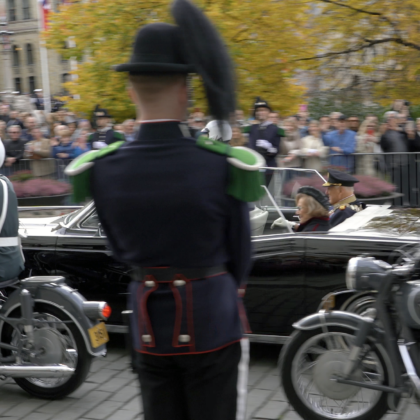
Across the square from the Habsburg Gate stands Sándor Palace. Count Vincent Sándor built this neoclassical mansion between 1803 and 1806. Since 2003 it has been the office of Hungary's president. In our Pest story, el-Sisi came here for talks with President Baka.
Two guards in olive greatcoats march in front of the green doors. Their rifles carry fixed bayonets, and the sentry box wears the red, white and green. The changing of the guard runs every hour on the hour, roughly 9:00 to 17:00. It is short and low-key, so arrive a few minutes early. On the last Saturday of the month, a military band joins in.

Guards march past the president's door at Sándor Palace
Rebuilt From the Ruins
Walk north from the palace along the cobbles toward Dísz tér. A tall domed building closes the end of the street. This is the former Royal Hungarian Army Headquarters, designed by Mór Kallina in the 1890s.
World War II bombs left only its lower floors standing. For decades the stump stood as a war memorial of sorts. Builders have now restored it, dome and all, under the National Hauszmann Program. The yellow and cream houses along the street look much as they did a century ago.

The rebuilt Army Headquarters closes the end of the street
Matthias Church and Fishermen's Bastion
The north end of Castle Hill holds the two sights everyone comes for. Walk along the cobbled lanes, and the white spire of Matthias Church appears between pastel houses. It pulls you forward like a compass needle.

The spire of Matthias Church pulls you down the lane
Matthias Church
Up close, the church stuns. The roof shines with glazed Zsolnay tiles in orange, green and cream diamonds. The Gothic tower climbs about 80 meters into the sky. A church has stood here since the 1200s, and Hungarian kings were crowned inside. Franz Joseph and Sisi took the crown here in 1867.

Zsolnay tiles shine on the roof of Matthias Church
Entry costs about 3,100 Ft for adults, with a separate ticket for the tower. Buy tickets at the kiosk across the square. We admired it from the outside, and the roof alone was worth the walk. The church closes early on Saturdays and opens only in the afternoon on Sundays for services.
Holy Trinity Square
The square in front of the church has its own landmarks. The Holy Trinity Column, a Baroque plague column from 1710 to 1713, rises with a golden cross on top. Locals built it to give thanks after the plague passed.
Behind it stands a neo-Gothic palace that looks like Parliament's little brother. Sándor Fellner designed it as the Ministry of Finance in 1901 to 1904, matching the church's style. War damage and a plain 1960s rebuild stripped its towers. Restorers put them back, and the Ministry of the Interior has now moved in.

The Holy Trinity Column and the restored neo-Gothic ministry
Fishermen's Bastion
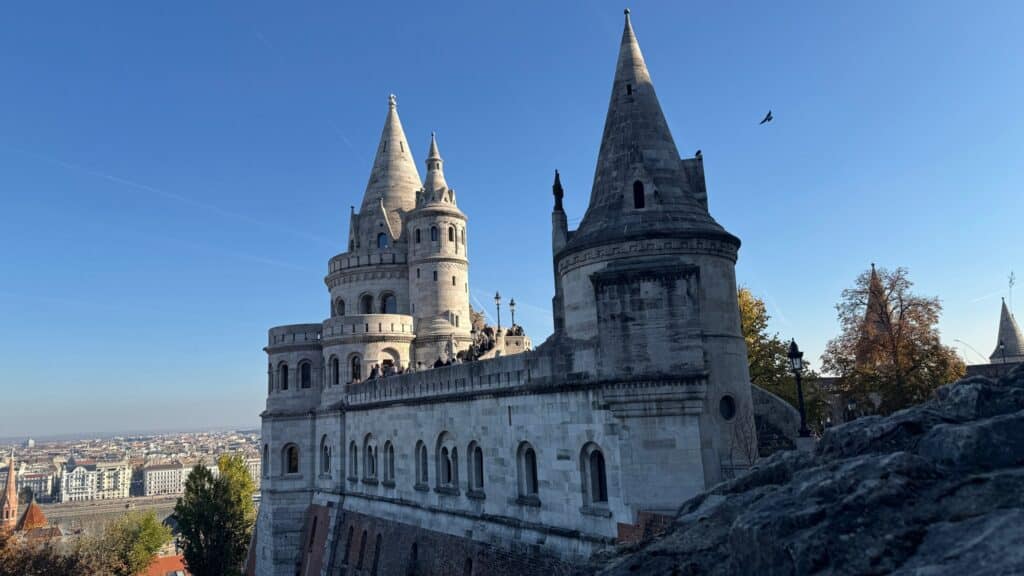
Fishermen's Bastion in the Buda side of Budapest looks medieval, but it is younger than the Statue of Liberty. Frigyes Schulek built it from 1895 to 1902 as a lookout terrace. Seven pointed towers stand for the seven Magyar tribes. The name honors the fishermen's guild that once defended this stretch of wall.
Most of the bastion is free at any hour. Only the upper turret walkways charge a fee, 1,700 Ft for adults. That fee applies from 9:00 to 19:00 in autumn and winter, and 9:00 to 21:00 in summer. Come early or after dark, and the upper level is free too.

The free lower terrace of Fishermen's Bastion
The view is the reason to come. Below the arches, the Danube runs past river cruisers. St Stephen's Basilica rises over the Pest rooftops, with Puskás Aréna on the horizon.

St Stephen's Basilica rises over Pest from the bastion
Buda After Dark
The best view of Buda at night comes from Pest. Walk the Pest embankment after sunset, and the whole hill lights up gold. We took these night shots from the Danube bank on the Pest side.
Buda Castle glows along the ridge, its dome floating over the dark slope. A little north, Matthias Church and Fishermen's Bastion shine like a fairy-tale set. Dinner cruise boats slide past below, their lights rippling on the water.

Buda Castle glows gold over the river at night
Bring a phone with a night mode, or brace your camera on the river wall. Tram 2 along the Pest bank gives you the same view on the move.

Matthias Church and the bastion shine above a dinner cruise
A Half Day on the Buda Side of Budapest
Castle Hill fits easily into a morning or an afternoon. This route runs south to north, so you finish at the best viewpoint.
- Cross the Chain Bridge to Clark Ádám tér.
- Ride the funicular, or take bus 16, up to Szent György tér.
- Catch the changing of the guard at Sándor Palace on the hour.
- Walk through the Habsburg Gate to Prince Eugene and the Danube terrace.
- Circle the palace to the Matthias Fountain.
- Stroll the cobbled lanes north past the rebuilt Army Headquarters.
- Visit Matthias Church and Holy Trinity Square.
- Finish on Fishermen's Bastion for the view over Pest.
- Come back after dark to see it all lit up from the Pest bank.
What It Costs (Nov 2026)
| Item | Adult price (2026) |
|---|---|
| Funicular, one way | 4,500 Ft |
| Funicular, return | 5,500 Ft |
| Bus 16 single ticket | 500 Ft |
| Fishermen's Bastion upper terrace | 1,700 Ft |
| Matthias Church | about 3,100 Ft |
| Habsburg Gate, Sándor Palace guards, lower bastion | Free |
Tips
- Wear flat shoes. Almost every street up here is cobblestone.
- Go early. By mid-morning, tour groups fill Fishermen's Bastion.
- Check which Mondays the funicular is closed before you go.
- Expect cranes. Rebuilding work continues across the hill.
Buda or Pest? See Both
Pest is where Budapest lives. Buda is where it shows off. One morning on Castle Hill gave us palaces, guards, a fairy-tale church and the best views in the city.
New to the city? Start with our first-timers guide to Budapest. Then cross the river with our Pest story, from Parliament to Heroes' Square. Next up, we wander the Jewish Quarter, from synagogues to ruin bars.
Explore and Discover




The Travel Tipster
I'm Ed Vasquez — The Travel Tipster. I've explored 35 countries and 100+ cities, almost always in a business class seat earned entirely through points. Firsthand destination guides, honest reviews, and practical points advice — from someone who has actually been there.