
Christmas markets by train
Christmas Markets by Train from Paris to Strasbourg, Basel and Stuttgart
Christmas markets by train make one of the easiest winter trips in Europe. We flew from the USA to Paris. From there, cheap trains carried us to Strasbourg, Basel and Stuttgart. Each market has its own history, its own food and its own way of serving mulled wine. In this guide, you will learn what makes each one special. Along the way, you will also see what these markets look like in person.
Christmas Markets by Train Look Different in Real Life
Before you go, a word of caution about the photos you see online. Many Christmas market pictures on Facebook look almost unreal. Filters push the colors, add sparkle and erase the crowds. Some images go even further. In November 2025, AI pictures of a fake market at Buckingham Palace sent tourists to a market that never existed.
Every photo in this story comes straight from our cameras. As a result, you will see rain, wet cobblestones and plenty of people. That is the real thing. Even so, the markets still look wonderful, only in a warmer and more human way.
Christmas Markets by Train Start at Tuileries Market in Paris
For years, the big Paris market lined the Champs-Élysées and drew around 15 million visitors a season. Then a dispute with City Hall shut it down in 2017. A year later, the market found a new home in the Tuileries Garden. Today, about 100 wooden chalets sit between the Louvre and Place de la Concorde. Rides, games and a Ferris wheel make it feel part market, part fairground.
Arriving and Beating Jet Lag
After the overnight flight, we gave ourselves a full day to recover. We stayed at the Paris Marriott Opera Ambassador Hotel, within walking distance of the Tuileries. So we rested by day and headed out once the lights came on. That first evening, we wandered all the way to the Eiffel Tower. Gold lights covered it on a misty night, marking 75 years of human rights.

Our first night in Paris ended under the golden Eiffel Tower
What to Eat at the Tuileries
Surprisingly, the Paris market leans German when it comes to food. A giant swinging grill held saucisse blanche, Krakauer and Mettwurst, each about 10 euros with fries. Nearby, stalls sold crêpes, vin chaud and hot chocolate. Compared with Alsace, the food here feels more like fair food than tradition. Still, nothing beats a hot sausage on a cold Paris night.

The Tuileries market feels like a fairground with chalets

German sausages sizzle on a swinging grill in the middle of Paris
Christmas Lights Beyond the Market
In Paris, the whole city dresses up, not only the market. At Place Vendôme, Chanel hung glowing stars beside two huge trees. Nearby, the fashion house wrapped a corner building in giant pearls and black bows. Meanwhile, a golden ornament on the Faubourg Saint-Honoré stood big enough to step inside. Naturally, we took turns climbing in for photos.

Chanel stars and twin trees light up Place Vendôme
Christmas Markets by Train Make Getting Around Easy
The trains turned out to be one of the best parts of the trip. Tickets cost far less than we expected. Better yet, every station sits in the city, a short walk or tram ride from the markets. Each ride gave us a couple of hours to put our feet up and watch the countryside roll by. As a result, we never needed a car, a parking spot or a taxi.
First Stop: Strasbourg, the Capital of Christmas
Strasbourg holds one of the oldest Christmas markets in Europe, and the oldest in France. Its story begins with the Reformation. Protestant leaders wanted nothing to do with saints, so they dropped the old Saint Nicholas market. In 1570, they replaced it with the Christkindelsmärik, or market of the Christ Child. After moving around the city for three centuries, it settled on Place Broglie in 1871. Today, about two million people visit every year.
Where We Stayed in Strasbourg
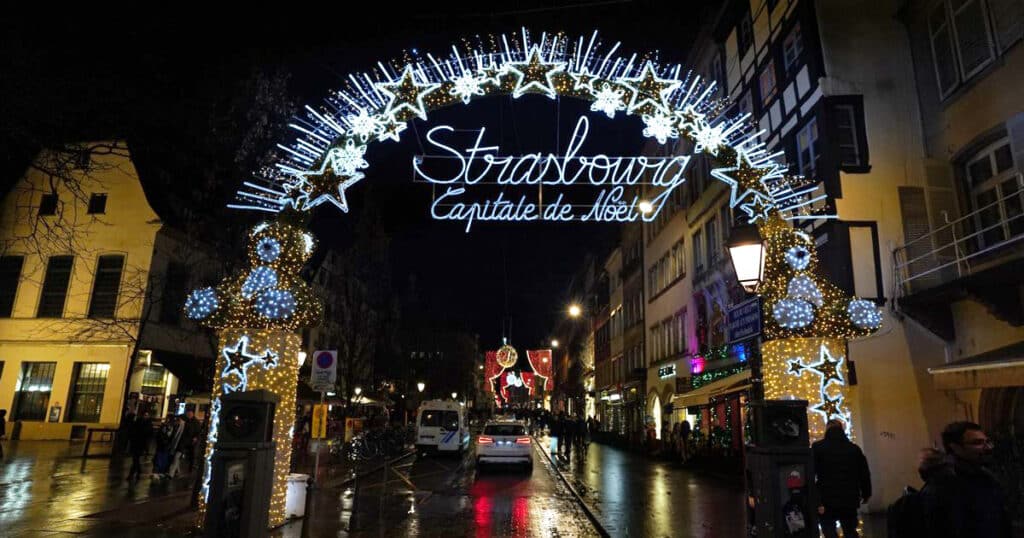
We stayed at the Residence Inn, about 3 km from the train station. From the station, we took the tram to the hotel. The markets sit about 2.5 km from the hotel, roughly a 15-minute tram ride. Strasbourg trams run often, so getting around never felt like a chore. Soon, a glittering arch reading Strasbourg Capitale de Noël welcomed us into the market.
The Cathedral, Petite France and Place Kléber
First, we walked up Rue Mercière under lighted angels blowing trumpets. Suddenly, the cathedral filled the end of the street. Stalls at its feet sold ornaments and painted nativity scenes, even in the rain.

The first Strasbourg market grew up around this cathedral in 1570
By day, we wandered Petite France among half-timbered houses and crowded lanes. Later, on Place Broglie, armed soldiers stood guard at the candy-cane entrance. That is part of the real picture today too.

Half-timbered houses frame the crowds in Petite France
At night, the Grand Sapin glowed over Place Kléber. Beneath it, the Village du Partage has hosted local charities since 2002.

The Grand Sapin and the Village du Partage on Place Kléber
What to Eat in Strasbourg
Strasbourg food tastes both French and German, much like Alsace itself. First, try vin chaud blanc, a mulled white wine made with local Alsatian wine. Next, grab a tarte flambée, a thin crust with crème fraîche, onions and bacon. For something sweet, look for bredele, small Alsatian Christmas cookies sold by the bag. Pain d'épices, a soft spiced gingerbread, fills the red Fortwenger chalet. Hungry visitors also line up for pretzels and choucroute.
The Strasbourg Cup
In Strasbourg, most stalls serve drinks in the same reusable market cup. You pay a small deposit, usually 1 euro, on top of your drink. Afterward, you can return the cup to any drink stall for your money. Better still, you can drop it in a donation bin, and your euro goes to a local charity. Or keep it, as many visitors do, for a cheap souvenir. A few chalets pour vin chaud into red ceramic mugs instead, like the one we brought home.
Christmas Markets by Train to Basel
From Strasbourg, we rode south through Alsace toward Switzerland. Along the way, the line passes Colmar, a town Facebook loves to call a fairy tale. We passed on it this time. To us, it looked small, and the online hype seemed bigger than the town.
Why Basel Stands Out
Basel runs the largest Christmas market in Switzerland. In 2021, European Best Destinations voted it the best Christmas market in Europe. About 150 stalls fill two old town squares, Barfüsserplatz and Münsterplatz. The market sits a short tram ride from Basel SBB station. Compared with Strasbourg, it felt calmer and a little more Swiss. Around the Barfüsserkirche, stalls sold wooden toys, leather bags and even treats from a dog bakery.

The mulled wine pyramid is the meeting spot in Basel
Does Basel Deserve Its Title?
So did Basel live up to its title? We found it good but not great. Of all the markets we have visited, Strasbourg remains our favorite. Vienna comes a close second. Basel landed around fourth for us. Still, it makes an easy and pleasant stop between Alsace and Germany.
What to Eat in Basel
Basel sits where France, Germany and Switzerland meet, and the food shows it. The star is Basler Läckerli, a hard spiced honey biscuit with almonds and candied peel. Jakob's, the oldest maker in town, has baked them since 1753. Next, watch a vendor scrape melted raclette off a half wheel of cheese onto potatoes. For a handheld version, order a Chäsbängel, a bread roll filled with hot cheese. Then wash it down with mulled wine at the pyramid.

Barfüsserplatz stalls glow at dusk below the Basel old town
Christmas Markets by Train End in Stuttgart
Stuttgart claims one of the oldest and biggest Christmas markets in Europe. City records first mention it in 1692, though its market rights go back to 1507. Today, around 300 stalls spread across four squares in the city center. Every year, more than three million people come, many by coach from across Europe. We stayed at Le Méridien, an easy walk from both the station and the market.

Mugs in hand, crowds fill the giant pyramid in Stuttgart
The Famous Stall Rooftops
Stuttgart is famous for the roofs of its stalls. Vendors compete every year for the best rooftop display. One roof held a full nativity scene with deer, owls and a toy train. Another showed giant gingerbread figures waving at the crowd. Below, gingerbread hearts reading Ich liebe Dich, or I love you, hung from every counter.
What to Eat in Stuttgart
Stuttgart food is Swabian, hearty and filling. Start with Maultaschen, large pasta pockets stuffed with meat and spinach. Then try Schupfnudeln, finger-shaped potato noodles fried with sauerkraut. Elsewhere, we watched whole mackerel grill on long sticks over charcoal. For dessert, roasted almonds and gingerbread fill dozens of stalls. Finally, look for Feuerzangenbowle, a hot punch topped with a flaming sugar cone soaked in rum.

Mackerel grilling on sticks over charcoal in Stuttgart
What Is Glühwein, and Why Is It So Popular?
Glühwein, pronounced roughly glue-vine, is German mulled wine. The name comes from glühen, the German word for glow. Centuries ago, people heated the wine with red-hot irons. Today, vendors warm red wine with cinnamon, cloves, star anise, orange and sugar. The oldest known Glühwein tankard belonged to a German count around 1420. He even fitted it with a lock so his servants could not sneak a sip.
So why does everyone drink it? On a freezing night, a hot mug warms your hands and your whole body. You can also try white Glühwein or order it with a shot of rum. For kids, stalls pour Kinderpunsch, a spiced fruit punch without alcohol. In France, the same drink goes by vin chaud.
The Stuttgart Mug Deposit
At the Stuttgart market, mulled wine comes in a real mug, not a paper cup. On top of your drink, you pay a deposit of about 3 euros. When you finish, bring the mug back to any stall or to a Pfandrückgabe return stand. However, watch your mug, because thieves sometimes grab empty ones to cash in the deposit.

Red deposit mugs on the table and the Pfandrückgabe return stand on the right
Collecting the Mugs
Mug collecting has become a tradition of its own. Each city has its own mug, so many travelers skip the refund and keep one as a souvenir. Over the years, some collectors fill whole shelves. We came home with three, one each from Stuttgart, Basel and Strasbourg. For us, a mug beats a fridge magnet any day.

Our three souvenir mugs from Stuttgart, Basel and Strasbourg
Do the Mugs Change Every Year?
It depends on the city. Basel changes its mug every year, both the picture and the shape. Each year, the artist who designs the badge for the Basel carnival, called Fasnacht, also designs the mug. Every mug carries the year and the Basel logo, and the city makes about 50,000 of them. For 2026, the mug turns yellow with a basilisk, the mythical creature on the Basel coat of arms.
Stuttgart changes far less often. Its red glass with a silver skyline first appeared in 2016, and we still drank from it years later. Strasbourg sits in between. Local guides say its mug design changes every year. Other markets pick designs in their own way. In Nuremberg, for example, the mulled wine sellers pool together, review an artist's sketches and vote for their favorite.
Schlossplatz After Dark
At night, the Schlossplatz turned into a garden of light. A golden horse reared in front of the Königsbau. Nearby, a silver horse leapt beside a glowing Ferris wheel. Over the stalls, a huge tree sparkled above vendors selling hot chestnuts.

A golden horse rears in front of the Königsbau
Dress for the Cold and other Tips Before You Go
These markets get cold, especially after dark when you stand still for hours. Look closely at our photos, and you will see heavy coats and hats everywhere. Dress in layers so you can adjust as you move between stalls and warm cafés. Next, wear waterproof shoes with good grip. Wet cobblestones turn slippery fast, especially in the rain. Finally, pack a warm scarf, a beanie and gloves.
Money, Timing and Crowds
First, bring coins for mug deposits and small purchases. Second, visit at dusk, when the lights come on but the crowds have not peaked. Weekends get packed, so plan your biggest market for a weekday. Pack an umbrella too, because rain fell in almost every city we visited. Above all, ignore the filtered photos online and trust your own eyes.
Christmas Markets by Train Are Worth It
In the end, we covered three countries and four cities with plenty of mulled wine along the way. Hotels near the markets or a quick tram ride away kept every stop easy. Between cities, cheap and relaxing train rides let us recharge. For us, Christmas markets by train made this one of our best trips ever.
Explore and Discover





The Travel Tipster
I'm Ed Vasquez — The Travel Tipster. I've explored 35 countries and 100+ cities, almost always in a business class seat earned entirely through points. Firsthand destination guides, honest reviews, and practical points advice — from someone who has actually been there.