

Helsinki City Center Walking Guide
Helsinki City Center Walking Guide includes Cathedrals, Poets, and a Church Carved Into Bedrock
After visiting Norway the year before and discovering how painless it was to get from Oslo's airport into the city center by train, I suspected Helsinki would offer the same kind of ease. I was right. The moment you land at Helsinki Vantaa Airport, just follow the signs to baggage claim, and a few meters past it you'll see the path leading down to the train platform.
Two commuter lines, the I train and the P train, run between the airport and Helsinki Central Station, and both take about 30 minutes. You don't need to think too hard about which one to catch, since either platform will get you downtown. A single adult ABC zone ticket costs €4.10, and you can't buy it on board. The HSL app is the usual way to buy one, but it wouldn't accept our US phone numbers to set up an account. So instead, we just tapped our card at the ticket machine on the platform, quick and painless.
First Impressions, A City Flying Ukraine's Colors
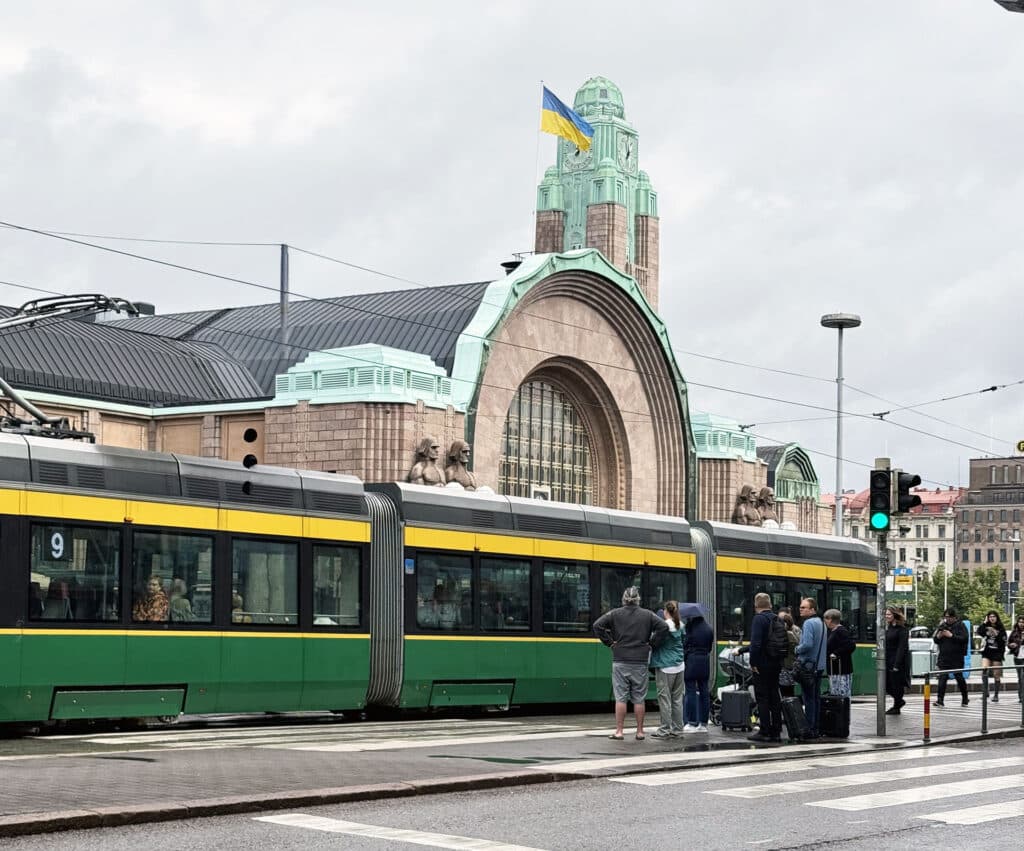
Helsinki Central Station's clock tower, with the Ukrainian flag flying above the stone-figure statues
Once we surfaced at the train station and looked back, we realized the flag we'd spotted was flying from the station's own clock tower, a striking sight next to its famous stone figure statues flanking the entrance. As we'd learn, this isn't unique to the station either. The Ukrainian flag has flown widely across Helsinki since Russia's invasion of Ukraine began, and it's typically only swapped out for Finland's own flag on national holidays. We noticed it again a few blocks later, flying from the Hotel Palace.
Every tram in the city seems to stop right in front of the central station, so it was simply a matter of catching the number 2 tram to the U14 Autograph Collection Hotel by Marriott. We could have walked it, but with a suitcase in tow, we didn't want to test our wheels against Helsinki's cobblestones. Twelve minutes later, the tram dropped us right at the hotel's doorstep.
Settling In at Hotel U14
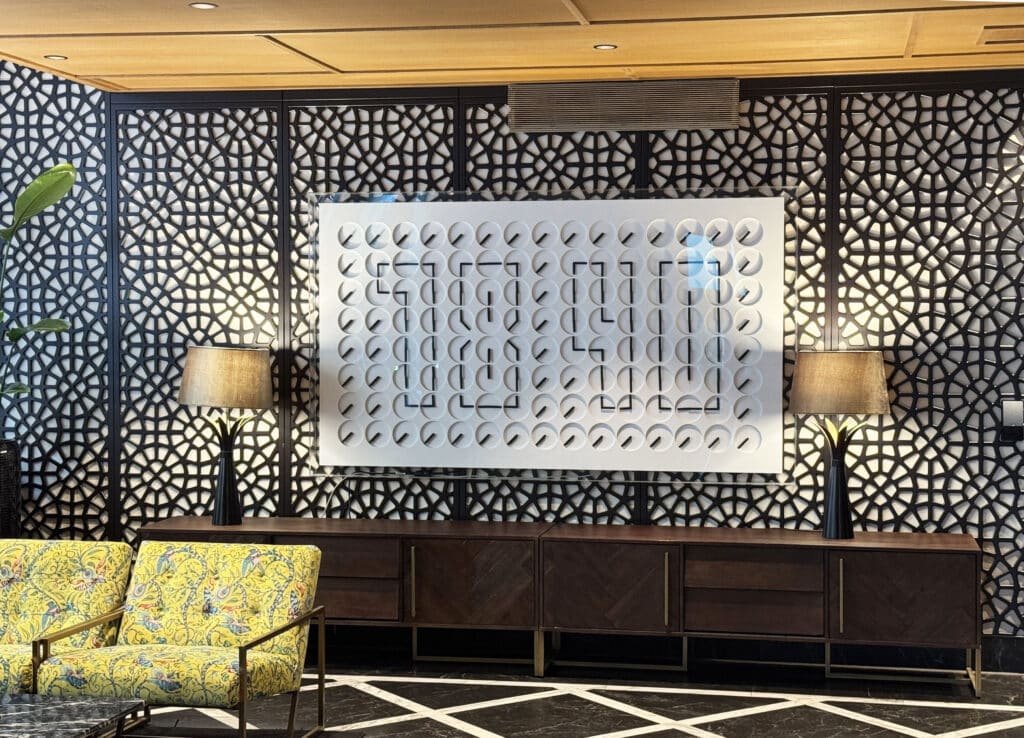
The lobby art piece at Hotel U14, its rotating panels spelling out the time
Hotel U14 sits on Unioninkatu, just steps from Esplanadi Park and Market Square, making it an ideal base for exploring the city center and for catching transportation onward to day trips outside Helsinki. The lobby has a genuinely fun piece of wall art. A kinetic puzzle piece installation rotates its panels to display the current time.
We picked U14 largely because we're Marriott Titanium Elite members, and the location on the map looked perfect for both sightseeing and transit connections. That instinct paid off. The elite breakfast buffet was outstanding every morning, a large but cozy restaurant with attentive staff and a spread generous enough that a hearty breakfast meant we were happy with a light lunch and an even lighter dinner. We'd booked the cheapest room category, and the hotel upgraded us to a nicely sized room with a king bed, a couch, and a chair. No complaints, and the bed was genuinely comfortable.
As a practical note, a large supermarket sits about two blocks up for snacks and drinks, and a liquor store (Alko) sits about the same distance away, which makes stocking the room easy.
Morning One, Observatory Hill Park
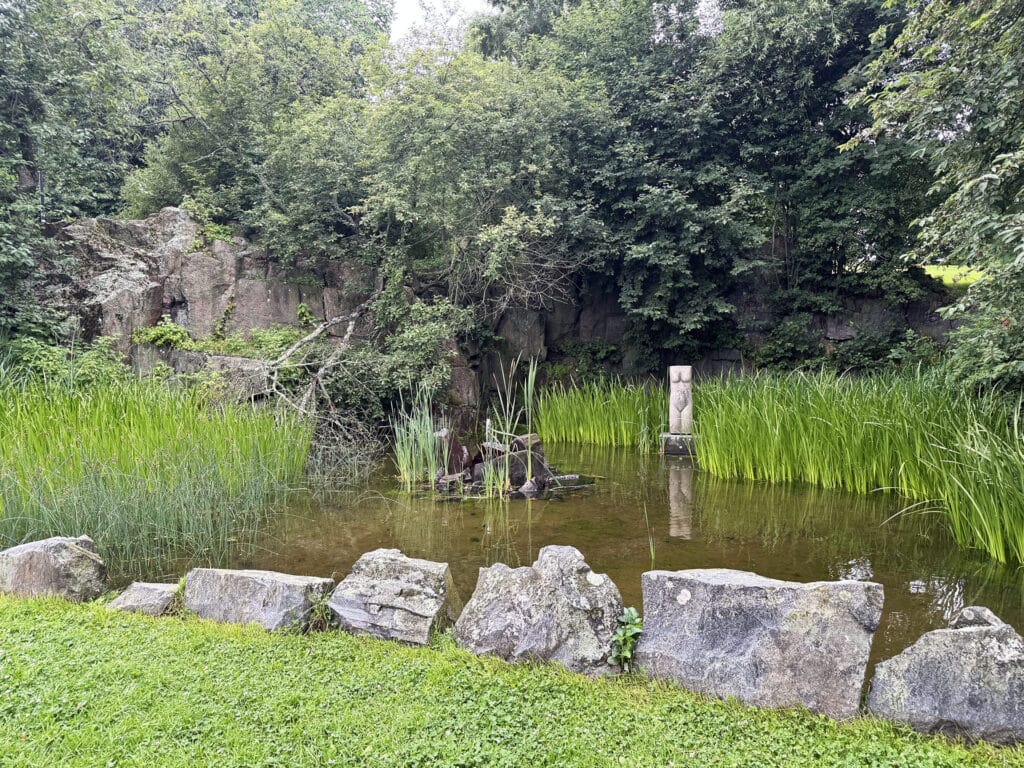
The pond in Observatory Hill Park, with the Torso sculpture standing among the reeds
My first morning, I got up early to explore the hotel's neighborhood on foot and ended up two blocks away at Tähtitorninvuori, Observatory Hill Park. It was Helsinki's first municipal park, built on a hilltop that was once part of a coastal chain of signal fire lookout points. The views from the top, over the South Harbour toward Katajanokka and Suomenlinna, are fantastic, and the old Helsinki Observatory building, designed by Carl Ludvig Engel and completed in 1834, sits right at the summit.
The park's small pond has held a rotating cast of artwork over the decades. A marble sculpture called Wader, donated in 1925, once stood there before conservation concerns moved it indoors. Since 2008, the pond has carried a red granite piece called Torso, by sculptor Marjo Lahtinen.
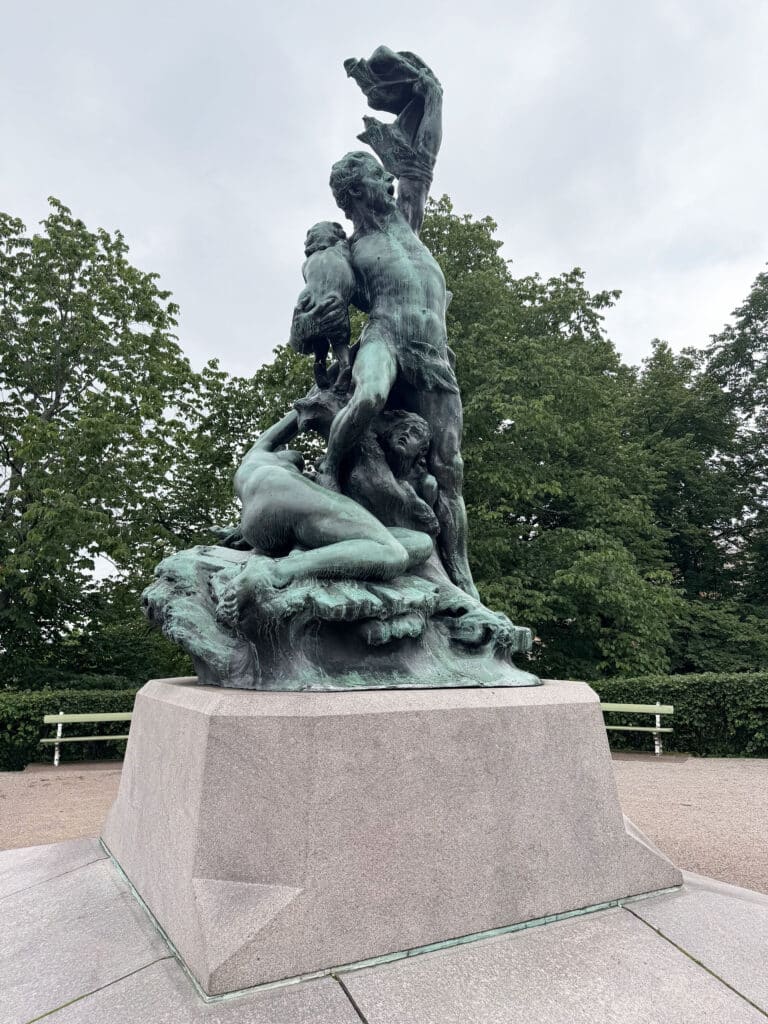
The Shipwrecked, overlooking the South Harbour
Wandering further through the park, I found two more moving monuments. The Shipwrecked, a dramatic 1898 bronze by Robert Stigell, depicts a shipwrecked family, long read as a quiet political statement about Finland's struggles under Russian rule at the time. Hands Begging for Mercy, a somber 2000 memorial, honors the eight Jewish refugees Finland handed over to Nazi Germany in 1942, of whom only one is known to have survived. There's also an actual shipwreck memorial nearby, a granite obelisk honoring 123 German soldiers who died when their ship, the Habsburg, sank in the Baltic on October 16, 1918, while supporting Finland's War of Independence.
Leaving the park, you get a beautiful view of Helsinki Cathedral and Senate Square in the distance, along with the wharf below.
Helsinki City Center Walking Guide, Give It the Time It Deserves
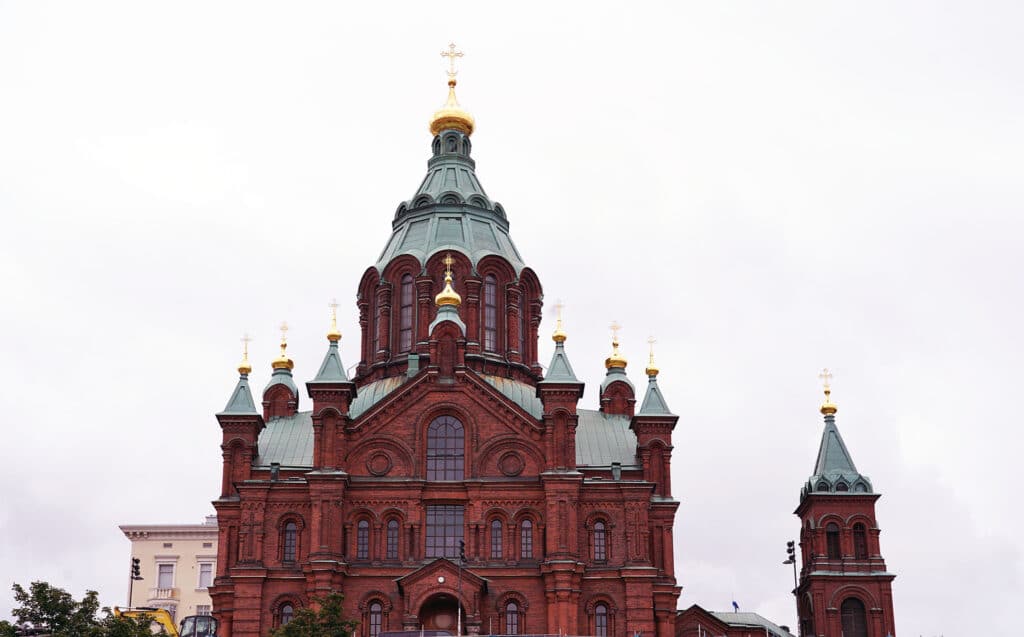
Uspenski Cathedral's onion domes up close
Exploring Helsinki's city center could take a single day, or you could easily stretch it to two or three, depending on your pace.
Market Square (Kauppatori) forms the heart of it, with bright orange tents selling prepared food like salmon, roasted potatoes, and salmon soup, alongside fresh berries and vegetables straight from Finnish farms. Right in the middle of the square stands the Empress Stone, a granite obelisk topped with a gilded double headed eagle. This is Helsinki's oldest public monument, raised in 1835 to mark Empress Alexandra's first visit to the city. From the tent area, you can't miss the onion domes of the Uspenski Cathedral, the largest Orthodox cathedral in Western Europe. Stepping inside, the interior feels elegant and offers a striking reminder of a different era.
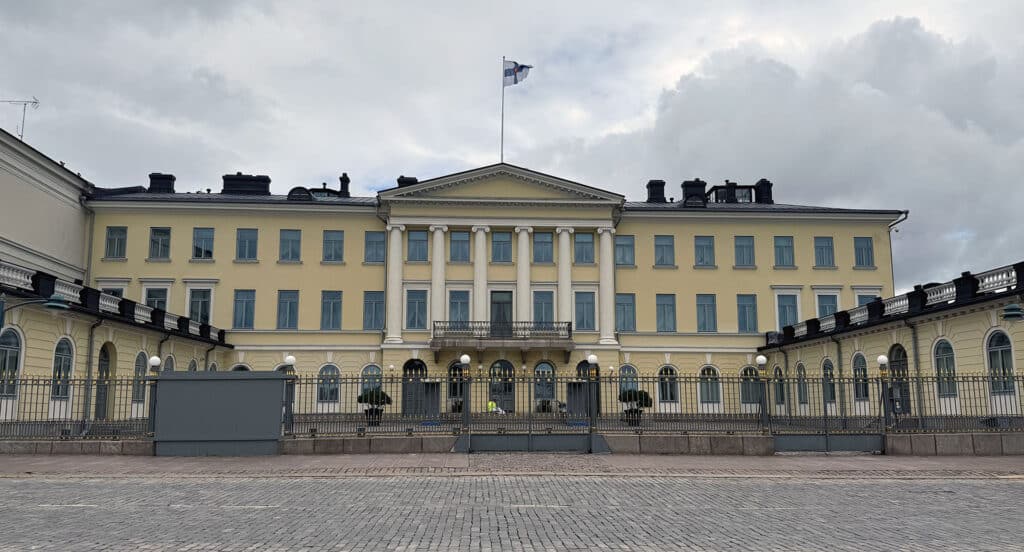
The Presidential Palace on the wharf
The Presidential Palace sits right on the wharf, next to the public ferry terminal for Suomenlinna sea fortress, or a longer trip out into the Baltic. A changing of the guard happens here, and it's worth timing your visit around. Just past the ferry terminal, the floating Allas Sea Pool offers a year round outdoor swim right on the harbor, saunas included, if you want to break up the sightseeing. From there, a short walk leads up to Senate Square, anchored by the grand white Helsinki Cathedral.
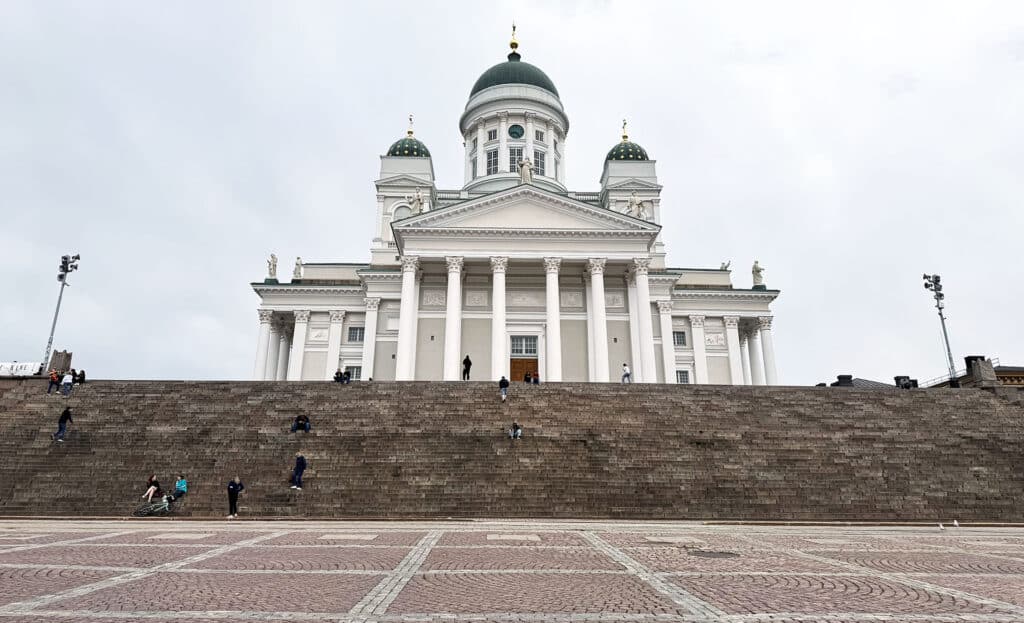
Senate Square and Helsinki Cathedral
Continue on and you'll hit the high end shopping streets, home to luxury retailers like Louis Vuitton, before arriving at Esplanadi Park, genuinely one of the most relaxing green spaces in the city center. It runs about a kilometer end to end, lined with benches and studded with two notable monuments.
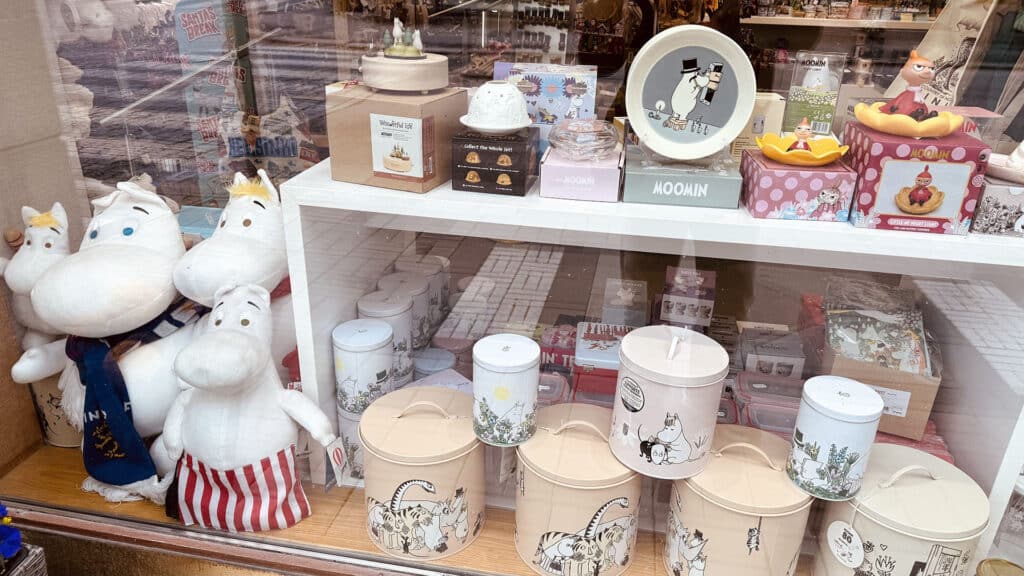
A Moomin shop window, packed with merchandise
You'll also notice Moomin shops on practically every block, so it's worth knowing who's staring back at you from all those mugs and plush toys. The Moomins are a family of round, hippo like trolls created by Finnish author and illustrator Tove Jansson, first appearing in a 1945 novel and later in a long running comic strip. They live in Moominvalley, a gentle, slightly melancholic world of forest and sea, and the books have made Jansson one of Finland's best loved cultural exports. In fact, the character shows up on everything from teacups to tote bags across the city.
Esplanadi Park's Poets
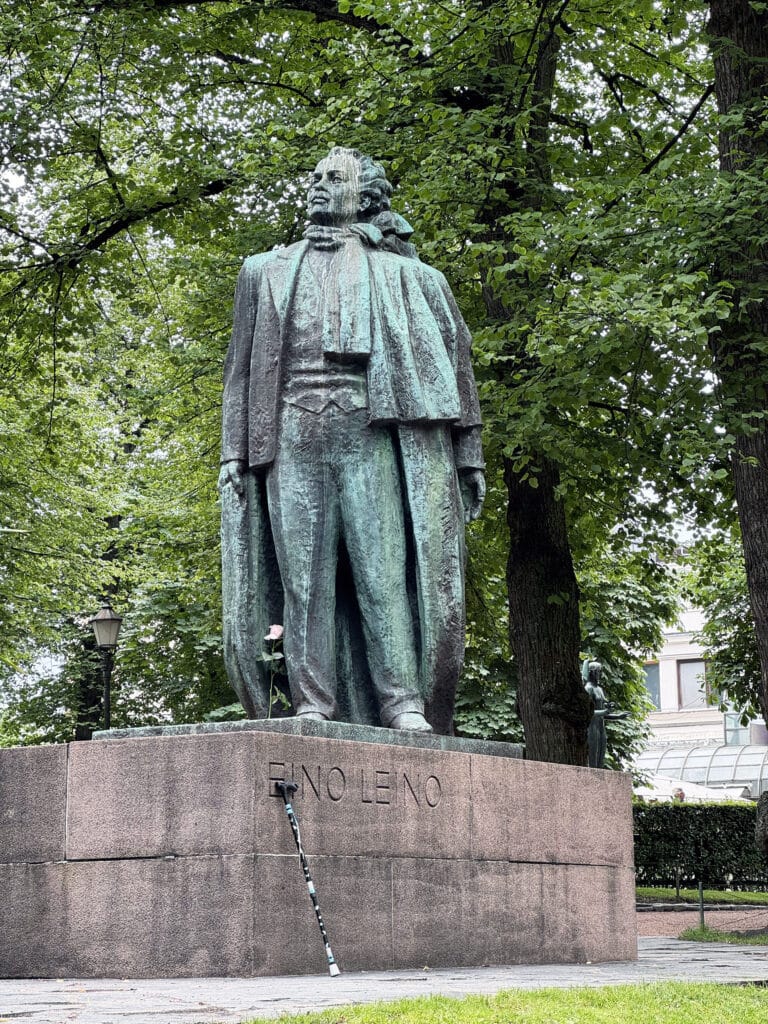
The Eino Leino statue, with a rose left at its base on his day
We happened to be there on Eino Leino Day (July 6), and it's a bigger deal than it might sound. Eino Leino (1878 to 1926) counts as one of the founding figures of modern Finnish language poetry. He published his first poem at age 12 and became one of the country's most quoted literary voices, with lines from his work still showing up in everyday speech. His bronze memorial in the park, unveiled in 1953 on the anniversary of his first published poem, stands 4.2 meters tall and carries an engraved line from his poem Väinämöisen laulu. Every July 6, Finland marks the day as an unofficial celebration of poetry and summer, and Esplanadi's outdoor stage runs a themed program to match.
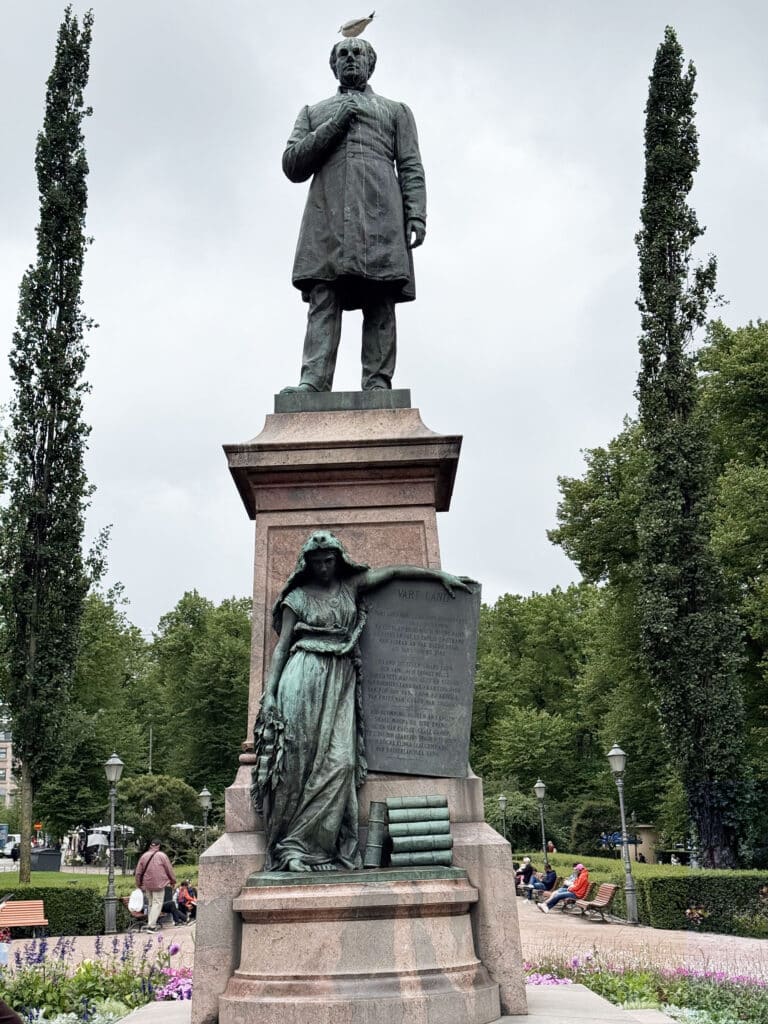
The Runeberg statue at the western end of Esplanadi Park, with the "Vårt Land" inscription below
The park's other literary monument, at the opposite end near Mannerheimintie, honors Johan Ludvig Runeberg, Finland's national poet, whose words open "Vårt Land" ("Our Land"), the text later set to music as Finland's national anthem. Runeberg's own son Walter sculpted the statue, unveiled in 1885, and it carries the poem's opening lines as an inscription.
At the corner where the park meets the orange market tents, you'll find Helsinki's most photographed piece of public art, the Havis Amanda fountain. Ville Vallgren sculpted it in Paris, and the city installed it here in 1908. It depicts a bronze mermaid rising from the sea, standing on a bed of seaweed and surrounded by water spouting sea lions, meant to symbolize the rebirth of the city. Every April 30th, university students ceremonially wash her and crown her with a white student cap to kick off the Vappu (May Day) celebrations.
Shopping, the Rock Church, and a Smarter Way to Sightsee
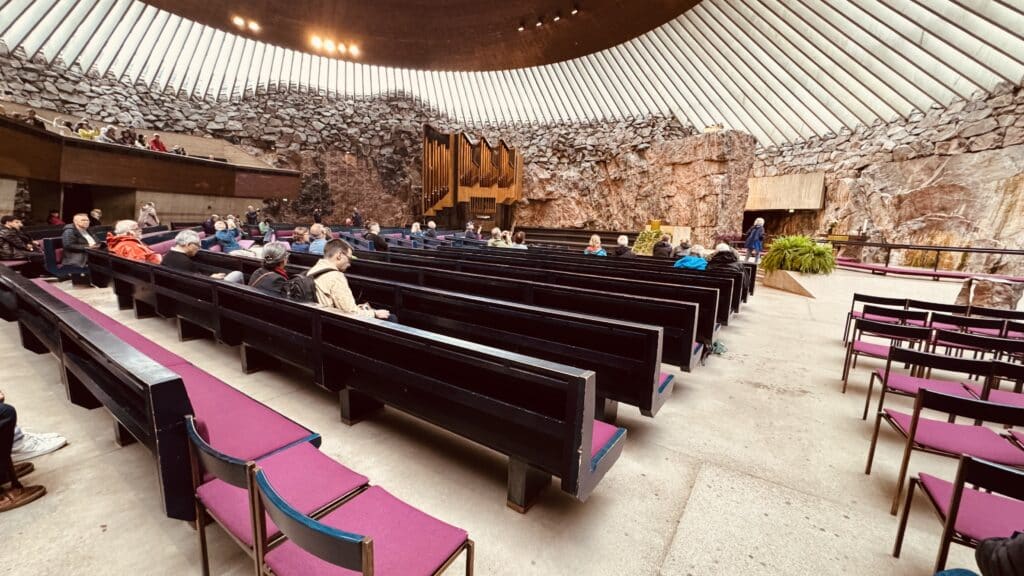
Inside the Rock Church, its walls left as raw excavated granite
From the park, you'll reach the Kamppi Shopping Center, packed with high end shops, with the long distance bus terminal at the bottom level. Near the Esplanadi's western end, close to the Stockmann department store, keep an eye out for the Three Smiths statue, three nude bronze figures hammering in unison and a well known meeting point landmark in its own right.
My wife's back was giving her trouble, so on our first day she rode the hop on hop off bus around the city while I explored more on foot. That turned out to be a smart way to scout the whole city before deciding where to actually spend real time. The ticket stays valid for 24 hours, so before it expired the next day, we used it again to ride out to Temppeliaukio Church, the famous "Rock Church" carved into bedrock, which saved us the walk out to the edges of downtown.
Where to Eat
There's no shortage of food in the city center, but for fresh salmon, the orange tents at Market Square beat every restaurant we tried. For pizza, La Galleria and another well reviewed pizzeria nearby both earned their reputations.
Music, Chairs, and Chilling Out
Esplanadi Park has its own small performance venue, the historic Espa Stage (Espan lava), running free concerts across the summer, everything from jazz and folk to rock, often right across from Restaurant Kappeli. It's unassuming, but it's a genuinely nice place to sit, relax, and listen for a while.
There's also Superterassi, a seasonal outdoor food and entertainment terrace that pops up every summer at Kasarmitori Square, near Unioninkatu and the S Market across from the hotel. It offers comfortable seating, a full lineup of food and drink vendors, and a different act on stage most nights, ranging well beyond disco and rock. Clearly a local favorite, it stays packed even on a grey afternoon.
Give the city center more time than you think you need. There's a reason Finland keeps topping the world happiness rankings. Helsinki has a way of making you slow down and just enjoy being there. Use our Helsinki City Center Walking Guide to help you.
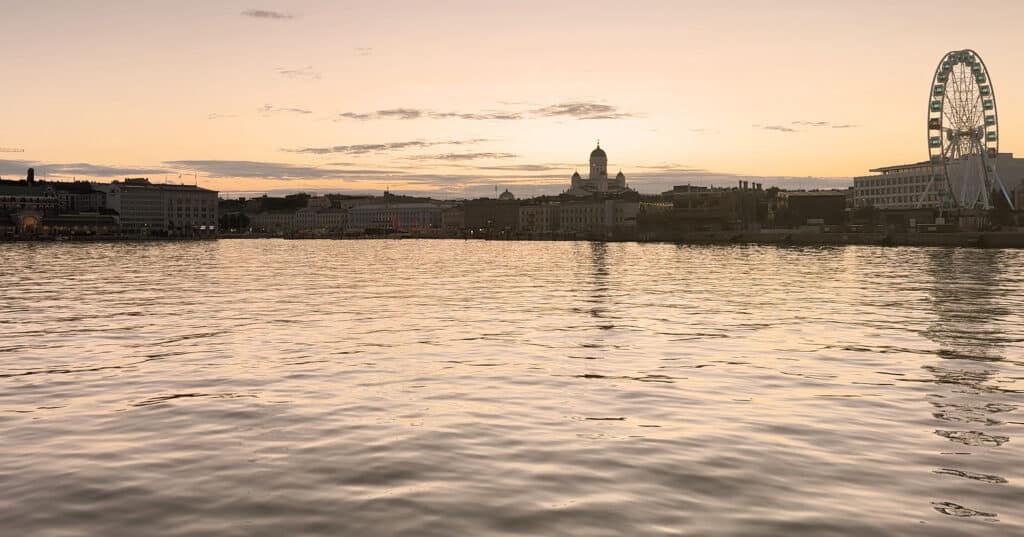
Helsinki's skyline at dusk, the cathedral dome and SkyWheel silhouetted over the water
To Summarize: Helsinki City Center Walking Guide Itinerary
Hotel U14 to Tähtitorninvuori (Observatory Hill)
Depart Hotel U14 on Unioninkatu and head south up Unioninkatu toward the quiet greenery of Tähtitorninvuori park. Walk up to the historic Helsinki Observatory (Helsingin yliopiston observatory) for panoramic views across the South Harbour and out toward the Gulf of Finland.
Observatory Hill to Market Square (Kauppatori)
Descend the hill along Laivasillankatu toward the waterfront basin. Enter Market Square (Kauppatori), weaving through the bustling stalls filled with yellow vendor tents, seasonal berries, and local handicrafts.
SkyWheel, Presidential Palace & Uspenski Views
Continue east through the market toward the Katajanokka canal. Walk past the SkyWheel Helsinki ferris wheel and look across the street at the Neoclassical Presidential Palace. As you approach the canal bridge, striking elevated photo angles of Uspenski Cathedral begin to emerge above the waterfront.
Uspenski Cathedral & Changing of the Guard
Ascend the hill to Uspenski Cathedral, Western Europe's largest Eastern Orthodox church, to admire its red-brick facade and gilded onion domes. Head back down toward the harbor to witness the ceremonial Changing of the Guard at the Main Guard Post (Päävartio), directly adjacent to the Presidential Palace.
Senate Square & Helsinki Cathedral
Turn inland along Aleksanterinkatu into Senate Square. Stand at the center of Carl Ludvig Engel's Neoclassical architectural ensemble and take in the massive white facade and zinc apostle statues of Helsinki Cathedral rising above the granite staircase.
Esplanadi Park
Walk back toward the harbor grid and enter Esplanadi Park. Stroll west along the central tree-lined path past historic statues, the open-air Espa Stage, and preserved 19th-century storefronts along Pohjoisesplanadi.
Helsinki Central Station
Exit Esplanadi to the west, cross Mannerheimintie, and follow Kaivokatu straight to Helsinki Central Station (Helsingin päärautatieasema). Conclude your walk outside Eliel Saarinen's Art Nouveau masterpiece, framed by the famous Lyhdynkantajat ("Lantern Bearers") granite statues guarding the main entrance.
Related Content:
Explore and Discover


The Travel Tipster
I'm Ed Vasquez — The Travel Tipster. I've explored 35 countries and 100+ cities, almost always in a business class seat earned entirely through points. Firsthand destination guides, honest reviews, and practical points advice — from someone who has actually been there.