
Budapest Jewish Quarter
Budapest Jewish Quarter at a glance
The Budapest Jewish Quarter packs three synagogues, a ghetto story and the city's wildest nightlife into a few small streets. On both of our visits, we spent the time walking it from end to end. It packs a lot of history into a short walk.
The quarter sits in District VII, on the Pest side of the river. Locals call the district Erzsébetváros, or Elizabeth Town. It takes its name from Empress Elisabeth, the Habsburg queen everyone called Sisi.
Yes, that makes two Sisis on this trip. In our Pest story we stumbled onto Egyptian President el-Sisi laying a wreath at Heroes' Square. Here, Empress Sisi smiles down from a giant painted wall on Rumbach Sebestyén utca. The mural lists the old street names of the district, with 1882 at the top. That's the year Erzsébetváros got its name.
New to the city? Start with our first-timer's guide to Budapest. It covers getting around, food and where we stayed.

Empress Sisi watches over the district that bears her name
Budapest Jewish Quarter synagogues
Three great synagogues stand within a short walk of each other. Each one tells a different chapter of Jewish life in the city.
Dohány Street Synagogue
The Dohány Street Synagogue is the largest synagogue in Europe. Ludwig Förster designed it in 1859, with twin onion-domed towers and striped brick. It seats about 3,000 people.
Behind it, a silver weeping willow stands in the memorial park. Sculptor Imre Varga made it, and the names of Holocaust victims cover its metal leaves. Next to it, a small courtyard holds the graves of people who died in the ghetto.
An adult ticket costs 14,500 Ft. It includes a guided tour, the Jewish Museum, the Heroes' Temple and the memorial park. The complex closes every Saturday and on Jewish holidays.

Europe's largest synagogue anchors the quarter on Dohány utca

Every metal leaf on this willow carries a name
Rumbach Street Synagogue
A few blocks away, the Rumbach Street Synagogue shows off a bold Moorish look. A young Otto Wagner helped design it in 1872. Today it opens to tourists on Sundays only, so plan around that.
A marble plaque by the door tells a grim story. In August 1941, Hungary deported 16,000 to 18,000 Jews it labeled stateless. The Nazis murdered them at Kamenets-Podolsk. The synagogue served as an internment camp for some of the victims.

Moorish stripes and arches on Rumbach Sebestyén utca

A plaque remembers the 1941 Kamenets-Podolsk deportations
Kazinczy Street Synagogue
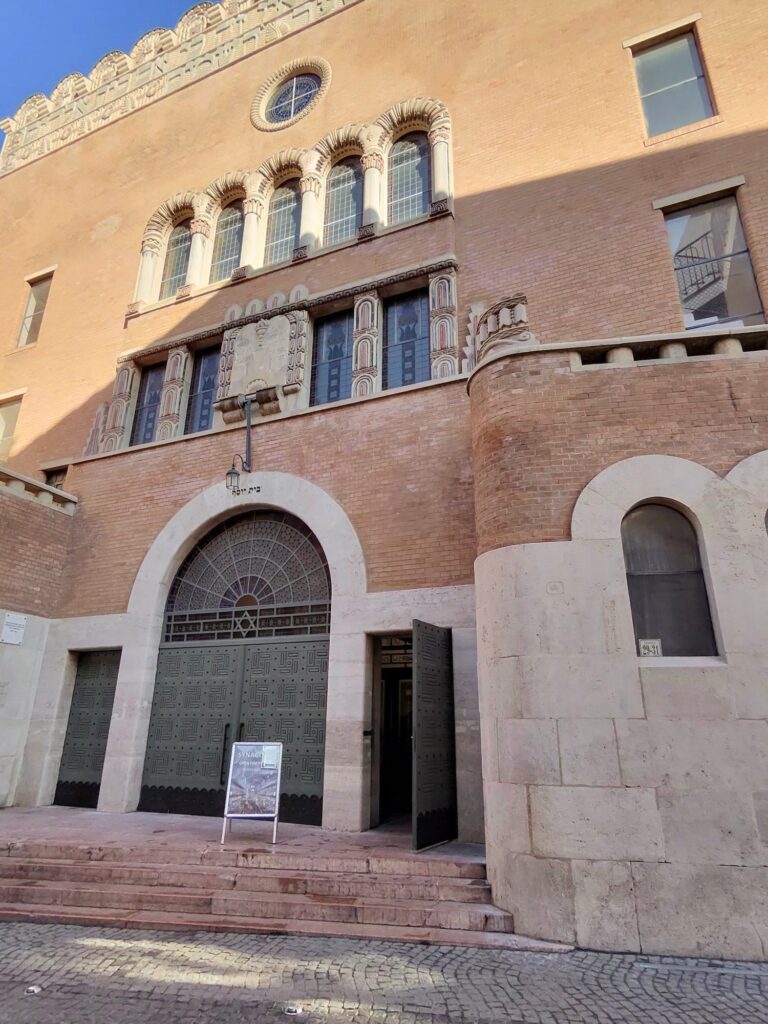
The Kazinczy Street Synagogue came last, in 1913. The Löffler brothers gave it an Art Nouveau facade and huge green doors. It still serves the city's Orthodox community. A sign out front said it was open for visitors, with tickets sold at the door.
The Kazinczy Street Synagogue still serves Budapest's Orthodox community
Budapest Jewish Quarter ghetto memorials
The quarter's darkest chapter hides in plain sight. You just need to look down.
Small metal strips sit in the pavement where the Pest ghetto once ended. Each one reads A pesti gettó határa, or the border of the Pest ghetto, in Hungarian and Hebrew. The dates run from 10 December 1944 to 18 January 1945. Roughly 70,000 people lived crammed inside until the Soviet army arrived.

A strip in the sidewalk marks where the ghetto ended
The ghetto wall
Next, we found the last piece of the ghetto wall in a courtyard on Király utca. A plaque explains that mostly children, women and older men lived behind it. Thousands never saw liberation. Builders tore down the original wall in 2006, and a memorial wall replaced it in 2010.
A notice said the guided exhibition had closed for now. You can still view the wall on your own for 5 euros or 1,500 Ft. The price includes a coffee or soft drink.

The plaque at the last stretch of the Budapest ghetto wall
Carl Lutz, the Swiss rescuer
On Dob utca, two memorials honor Carl Lutz. As Swiss vice-consul, he issued protective papers and set up safe houses. He saved tens of thousands of Hungarian Jews.
A rough stone carries a line from his diary. In English it reads "I go mad when I suddenly have to decide whom to save. Where is God?" Nearby, a bronze plaque quotes the Talmud. "Whoever saves a life is considered as if he has saved an entire world."

Carl Lutz wrote these words while deciding whom to save

A Talmud verse honors Lutz and his team
Budapest Jewish Quarter today
After the memorials, the mood shifts fast. The same streets now buzz with cafes, street art and ruin bars.
Giant murals cover the firewalls. One standout sits on Miénkitta tér. It shows the rock band LGT, painted for the 50th birthday of their 1973 hit "Miénk itt a tér." The title means "the square is ours," and the square now carries the name.

Hungarian rock legends LGT own this wall on Miénkitta tér
Mika Tivadar Secret Museum
On Kazinczy utca 47, a garden gate hides the Mika Tivadar Secret Museum. It packs ten small exhibits into 140 square meters. Topics range from the Budapest ghetto to the first Hungarian steam bath. A free audio guide comes in eight languages, and it opens daily from 8am to 10pm.
Next door, Mitico serves an all-you-can-eat brunch buffet from 7am to 1pm. It costs 12 euros on weekdays and 14 euros at weekends. Brunch guests get into the museum free.

A garden gate on Kazinczy utca leads to the secret museum
Ruin bars
At night, the quarter belongs to the ruin bars. Owners filled crumbling courtyards with mismatched furniture and cheap drinks. Szimpla Kert on Kazinczy utca started the trend. We cover the late-night side in our Budapest after dark story.
Budapest Jewish Quarter tips
A little planning helps, because each site keeps its own hours.
- Avoid Saturday for synagogues. Dohány closes for the Sabbath.
- Save Sunday for Rumbach. It only opens to tourists that day.
- Go early. From November to December, Dohány opens 10am to 4pm Sunday to Thursday and 10am to 2pm on Friday.
- Cover your shoulders and knees. Men get a kippah at the door.
- Walk from your hotel. The quarter lies about 20 minutes on foot from the Radisson Blu Béke.
- Allow half a day. Then come back after dark for the ruin bars.
In the end, the Budapest Jewish Quarter surprised us. One minute we read a name on a willow leaf. The next we laughed at a rock band mural. That mix of grief and life is exactly why it deserves a full morning. Next, we cross the river to Buda Castle Hill.
Explore and Discover



The Travel Tipster
I'm Ed Vasquez — The Travel Tipster. I've explored 35 countries and 100+ cities, almost always in a business class seat earned entirely through points. Firsthand destination guides, honest reviews, and practical points advice — from someone who has actually been there.