
Sigtuna Day Trip from Stockholm to Sweden’s Oldest Town
Where a Thousand Year Old Street Still Sets the Pace
A Sigtuna day trip from Stockholm is a bargain. Sigtuna sits inside Stockholm County, so the regular SL public transit network covers the whole trip. A single ticket costs about 42 SEK, roughly $4.50, and that covers everything you need. Stockholm Central runs two different kinds of trains. The commuter train is the one you want, and it's the cheap one you can tap and go. The regional trains cost extra, run on a separate fare system, and skip tap and go entirely. You won't need the regional trains for Sigtuna, though you will need them for the trip out to Gripsholm Castle. Keep the two straight from the start.
We took the commuter train out of Stockholm Central to Märsta. Once we sorted out which train was which, the rest turned into an easy ride. Three different buses wait right outside the Märsta train station, and all three drop you across the street from Sigtuna's main street. You don't need to overthink which one to catch or wait long to catch one.
AI as a Sigtuna Day Trip Personal Tour Guide

A couple walks hand in hand down cobblestoned Stora Gatan, past colorful wooden shopfronts and hanging Swedish flag bunting.
Stora Gatan is Sigtuna's main street, and once we were actually on it, figuring out what we were looking at got a little tricky. That's the moment it clicked. Use AI as a personal tour guide. I was using Gemini at the time, so I'd snap a photo, upload it, and ask if I was heading in the right direction. It would tell me what was ahead and the history attached to it. Anything that caught my eye after that got the same treatment. I'd photograph it, send it, and get an instant rundown of what I was looking at along with a heads up of what was coming next. It really did function like having a guide walking next to me the whole day. That one afternoon in Sigtuna is when it sank in that AI should be part of every journey.
Walking Stora Gatan

The street's buildings mostly date from the 1700s and 1800s. The road beneath them is a thousand years older.
Stora Gatan is the oldest main street in Sweden. The Viking king Erik the Victorious laid it out around 980 AD, nearly a thousand years ago. Wooden shops and cafés line it today, most dating from the 1700s and 1800s, but the street itself has never moved. People have been building and rebuilding here for a millennium, so the ground has physically risen. Walk it today, and you're standing roughly three meters above the original dirt and log road the Vikings used.
King Erik's design also served as a piece of early political theater. He laid out equal plots on either side of the street. He handed them to regional chieftains and merchant guilds. He gave them away rather than sold them, but the catch was that recipients had to build a house and actually show up. As a result, the plan pulled his rivals into town, flaunting their wealth, trading, and minting Sweden's first coins, all within reach of the king.
Runestones sit casually at the path's edge along the way. Wealthy families carved these Viking era billboards to advertise their travels or their lineage.
Stora Torget and the Rådhus

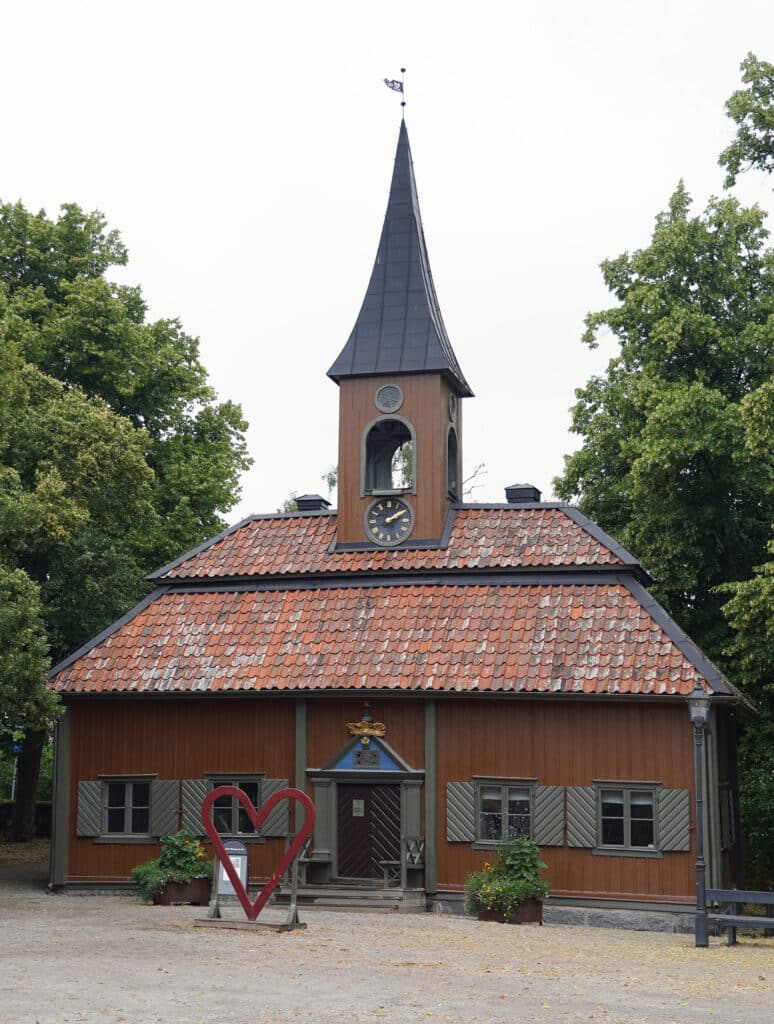
Framed by a giant red heart, with Sigtuna's 1744 Rådhus, reputedly the smallest town hall in Sweden, as the backdrop.

The same Town Hall, photographed nearly 70 years earlier, from the Sigtuna Museum's collection.
The street opens into Stora Torget, the main square, home to the tiny Sigtuna Rådhus, or Town Hall. The town finished it in 1744, and many consider it the smallest town hall in Sweden, maybe even in Europe. The town's own mayor, Lukas Westman, designed it, so it looks more like a fairy tale dollhouse than a seat of government. Step inside for free, and you'll find two tiny preserved rooms, an old courtroom and a former jail cell. Couples still choose it for weddings today, since it photographs so well.
The Sigtuna Museum and the Book Kiosk

The Sigtuna Museum, easy to spot by the dragon over the door. Inside sit Viking era silver coins dug up beneath the street.
A few steps past the square, at Stora Gatan 55, sits the Sigtuna Museum. A dragon head carving over the entrance makes it easy to spot. Inside, a small but genuine collection of Viking era silver coins and artifacts waits, all dug up right beneath the street outside.
Just past the museum, in a little courtyard called Lilla Torget, sits one of the town's most charming oddities. Someone converted a disused red telephone booth into a Bokkiosk, a public book exchange on the honor system. Locals and travelers alike swap books freely.

A disused phone booth turned into a Bokkiosk, a public book exchange on the honor system.

Inside the Bokkiosk. Take a book, leave a book, no questions asked.
The Church Ruins

St. Olof's Church, built around 1100 AD, still standing eight centuries after Sigtuna's golden age ended.
Turning toward the church quarter, you'll see the massive roofless stone arches of St. Olof's Church rise over the treetops. Builders raised it around 1100 AD, at the height of Sigtuna's power as Sweden's religious and royal center. The unusually short nave and imposing square tower suggest masons from England or Denmark built it. It fell into disrepair after King Gustav Vasa confiscated church wealth during the 1520s Reformation. Locals eventually salvaged its stones for their own homes, leaving the skeleton that still stands today. It's tall enough, and intact enough, that you can walk right around it, and you get a real sense of how imposing it once was.

The ruin's tower, framed by summer blooms, a softer angle on eight hundred year old stone.
St. Mary's Church, or Mariakyrkan, stands right beside the ruins. It dates to 1247, making it the oldest brick building in the region, and it's still an active church today, with medieval ceiling frescoes inside.
Down to the Water

Sigtuna's own lakefront boardwalk on Lake Mälaren, not to be confused with Stockholm's Strandvägen.
From the church quarter, a short flat walk leads to Sigtuna's own lakefront boardwalk on Lake Mälaren, not Stockholm's Strandvägen. Cold weather greeted us that day, with a light mist drifting in and out. Nothing stopped us, though. The wooden benches and loungers along the water felt like a genuine relief, not just a photo op. We sat for a while, just looking out at the lake. It was quiet, still, and peaceful in a way the main street hadn't quite been.

A quiet moment on the water, mist drifting over Lake Mälaren.
Lake Mälaren is why Sigtuna exists at all. During the Viking Age, it formed an open bay of the Baltic. That let longships sail straight into the sheltered heart of Sweden, safe from coastal raiders. Centuries of post glacial rebound eventually sealed it off from the sea, turning it into the freshwater lake it is today. Meanwhile, a new fortress town further downstream, Stockholm, took over as the region's trading hub once the water route narrowed, and Sigtuna's golden age quietly wound down.

The mini golf course scales down Sigtuna's own landmarks. This hole recreates the tiny 1744 Rådhus, tower and all.

This hole trades history for whimsy, sending your ball past a Viking longship and miniature versions of the town's own buildings.
Continuing along the road past the benches, we came across a small mini golf course. Its layout was more interesting than the usual setup, so it's worth a look if you're walking this stretch.
Tant Brun Kaffestuga

The storybook welcome outside Tant Brun Kaffestuga, Sigtuna's 17th century cafe.
From the mini golf course, we headed back toward the town square and found the old café. The name translates roughly to Aunt Brown. Tant Brun Kaffestuga sits inside one of the town's oldest surviving buildings, probably the oldest in Sigtuna, dating to the late 1600s. Fittingly, the café takes its name from a beloved Elsa Beskow children's book, Aunt Green, Aunt Brown, and Aunt Lavender, about three sisters living in a town that looks a lot like this one.
We stopped for a short coffee break, a coffee and a blueberry pastry. We also got a photo with the staff, who wore matching striped period pinafores that fit right into the café's storybook theme.

Inside Tant Brun. Coffee, a blueberry pastry, and a peek into one of Sigtuna's oldest buildings.

The staff at Tant Brun dress the part. Striped pinafores straight out of the cafe's storybook theme.
Heading Back from a Sigtuna Day Trip
From Tant Brun, a short walk led back to the bus stop. The bus arrived right on schedule, and the train was waiting for us when we got to the station. As a result, the journey back into Stockholm passed without incident, a good reminder of just how smoothly public transportation runs here.
Transit Options:
Public Transit / SL Ferry: Take SL Ferry Line 83 from Strömkajen or Slussen directly to Vaxholm. Standard SL transit tickets/passes are accepted. Alternatively, take Bus 670 from Tekniska högskolan (~50 minutes).
Commercial Ferries: Waxholmsbolaget or Cinderella boats run frequent departures from central Stockholm quays.
Ground Dynamics: The town center is compact and walkable. Waterfront paths and coastal rocks are largely level, with gentle inclines heading up into the historical residential streets.
Related Stories
Explore and Discover





The Travel Tipster
I'm Ed Vasquez — The Travel Tipster. I've explored 35 countries and 100+ cities, almost always in a business class seat earned entirely through points. Firsthand destination guides, honest reviews, and practical points advice — from someone who has actually been there.