

Porvoo Day Trip from Helsinki
Cobblestones, a Tsar's statue, and Finland's oldest chocolatier - inside a Helsinki to Porvoo day trip that's easily worth the full day.
A Porvoo day trip from Helsinki shows up on every "must visit" list, and for once, the hype holds up. Finland's second oldest town carries a charter dating to 1346. Many Nordic old towns burned down or gave way to modern development, but Porvoo's wooden Old Town survived intact. People still live in it. It still looks exactly as photogenic as every picture promised.
Getting There

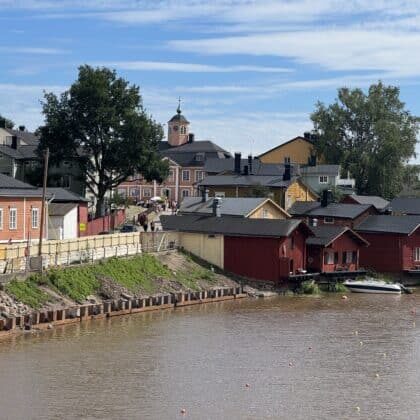
Red boathouses are a highlight of a Helsinki to Porvoo day trip.
Skip the guided tours. Public transportation makes a Porvoo day trip simple. Buses leave from the Kamppi bus terminal, specifically the long distance terminal (Kaukoliikenneterminaali) tucked into the lower level of the Kamppi shopping centre, a short walk from Helsinki Central Station. One retail shop sits on the lower floor, and you can buy a ticket there. The ride to Porvoo runs comfortable and easy, taking about 50 minutes to an hour. The bus drops you about a block from Main Street, and you cross it to enter the Old Town proper.
First Stop: The Cathedral on the Hill

Walking up from Main Street, you hit Porvoo Cathedral first, perched on a hill overlooking the town. It's small compared to most cathedrals, since Porvoo itself is a small town, but it still feels genuinely impressive. This church holds a claim to the single most historically important room in Finland.
The cathedral traces back to the 13th century, though most of what stands today comes from a 1414 to 1418 rebuild, with additions through the 1450s. The architecture isn't really the point. What happened here on March 29, 1809 matters far more. Finland had just passed from Swedish to Russian control after the Finnish War, ending a 700 year union between the two countries. Tsar Alexander I, now Finland's new ruler, convened the Diet of Porvoo, an assembly of Finland's four Estates: nobility, clergy, burghers, and peasants. Inside this cathedral, they swore allegiance to him as Grand Duke of Finland. In return, Alexander I pledged to preserve Finland's own laws, its Lutheran religion, and the rights of its people.

That moment explains the statue of Alexander I standing inside the cathedral today. It's not decoration. It marks the exact event historians point to as the founding act of Finnish statehood. The Diet of Porvoo turned Finland into an autonomous Grand Duchy rather than an ordinary Russian province, complete with its own laws, its own Senate, and eventually its own currency, while the Tsar stayed a distant figurehead rather than a hands on ruler. That century of self governance let a distinct Finnish national identity, language, and legal system take root. It became the entire runway toward full independence in 1917. Stand in that spot and you're standing at the actual hinge point of modern Finnish history.

Look up while you're inside and you'll spot something easy to miss: a wooden ship model hanging from the ceiling. This votive ship reflects a tradition in seafaring churches across Scandinavia and coastal Finland, where parishes hung model ships as offerings for protection and safe passage at sea. Porvoo worked as a trading port for centuries, so the tradition fits right in.


The interior stays understated by cathedral standards: simple whitewashed vaults, an ornate old organ loft, and walls hung with carved heraldic memorial plaques, coats of arms for prominent local families and clergy, a common feature in old Nordic churches, instead of elaborate gilding.
The Devil's Staircase and the Cobblestones That Fight Back

Walking down from the cathedral through the older lanes, you'll pass a spot marked with an old sepia photograph from decades ago: the so called Devil's Staircase (Koulukujan Pirunportaat), a steep stretch of stone steps cut into the bedrock between two buildings. The name promises more menace than it delivers. It's really just a steep, awkward staircase that probably felt treacherous enough on a dark winter night to earn the nickname.

Speaking of awkward footing, Porvoo's Old Town streets skip the flat, rectangular cut stones ("setts") most old European towns use and that most people picture when they hear "cobblestones." Porvoo's are the real, original article: naturally rounded field stones and river cobbles, set directly into the ground. They're historically correct and undeniably charming, and they will absolutely test your ankles. Wear real shoes.
Down to the River: The Red Boathouses

One image sums up Porvoo more than any other: a row of red wooden boathouses lining the Porvoo River, their reflections sitting still in the brown water. Head for the bridge. It gives you the best vantage point for the classic shot, looking down the row toward the pink Old Town Hall tower in the distance.
Photographers didn't build these boathouses. Traders used them for centuries as warehouses to store and load the salt, tar, and goods moving through Porvoo's river trade. The color comes from traditional Falu red, an iron oxide paint used across Sweden and Finland on barns and outbuildings for its low cost and durability, though the looks turned out pretty good anyway. During our visit, active construction lined the riverbank, with pile driving equipment and a barge working the shoreline, a reminder that a historic old town never really stops maintaining itself.

A little further along, the river opens out into a calmer, more rural stretch, a nice contrast to the density of the boathouse row.
Into the Old Town: Lively, Not a Museum

Cross back up into the Old Town proper and the atmosphere shifts completely. This isn't a preserved in amber museum piece. It's a living, busy town center. Musicians play on the cobblestones, cafés spill out onto the squares, and the narrow lanes stay genuinely crowded with people browsing shops.

We caught a street violinist working the main pedestrian lane, about as good as ambient old town atmosphere gets.

Take your time here and actually wander the side streets. Porvoo rewards you for not rushing straight to the boathouses and back. Every narrow lane seems to dead end into another colorful facade or another café terrace.
The Poet's House


Wandering those side streets, you'll run into the Runeberg House, the blue house behind the red picket fence, marked with a small plaque. Johan Ludvig Runeberg holds the title of Finland's national poet, best known for writing the words behind Finland's national anthem. He lived in this house from 1837 to 1838, early in his career, long before his face turned up on Finnish currency and his birthday (February 5) became a national flag day.
Chocolate, and a Quick Grocery Run
That strawberry and raspberry stall photo in this set didn't actually come from the Old Town. It came from a shopping center grocery store right next to the Porvoo bus terminal, where we ducked in for water before heading back. Porvoo isn't only the postcard part. It's a real, functioning town with a real bus terminal and a real grocery store, and sometimes that's exactly the stop you need.
The chocolate, on the other hand, came straight from the Old Town. Brunberg, the town's confectionery since 1871, lives up to its reputation. We bought a couple of bags and they didn't last long. Brunberg also makes a well known version of Runeberg torte around the poet's February birthday, tying the town's two most famous names, the poet and the chocolatier, together in the best possible way.
The Square, and Lunch at Café Fanny

Every wandering route in Porvoo eventually spits you back out onto the main square, anchored by the Old Town Hall, the pink building with the clock tower that shows up in half of Porvoo's postcards. It dates to 1764 and now houses the Porvoo Museum, but its real significance runs simpler than that. For centuries this building served as the literal seat of town government, the civic heart of Porvoo, the same way old town halls anchor town squares across the Nordics.

We stopped for lunch at one of the cafés ringing the square, Café Fanny, with its outdoor umbrellas and a steady stream of people drifting past all afternoon. It's a good spot to sit, eat, and just watch the town go by before heading back to the bus.
Our Final Thoughts on a Porvoo Day Trip
Porvoo rewards slowness. It's small enough to see the highlights in a few hours, but it's built for wandering. Every side street off the main drag hides something worth finding, whether that's a quiet lane, a historic plaque, or just a good bench to sit on. The cathedral's outsized role in Finnish history, the boathouses' working town origins, and streets that stay genuinely lived in rather than roped off, together earn a Porvoo day trip its reputation as the best one day escape from Helsinki.
Related Content:
Explore and Discover



The Travel Tipster
I'm Ed Vasquez — The Travel Tipster. I've explored 35 countries and 100+ cities, almost always in a business class seat earned entirely through points. Firsthand destination guides, honest reviews, and practical points advice — from someone who has actually been there.