

Stockholm Vasa Museum on Djurgården
A ferry ride past Gröna Lund, a stop at ABBA The Museum, an aquavit tasting, and an afternoon inside the Stockholm Vasa Museum
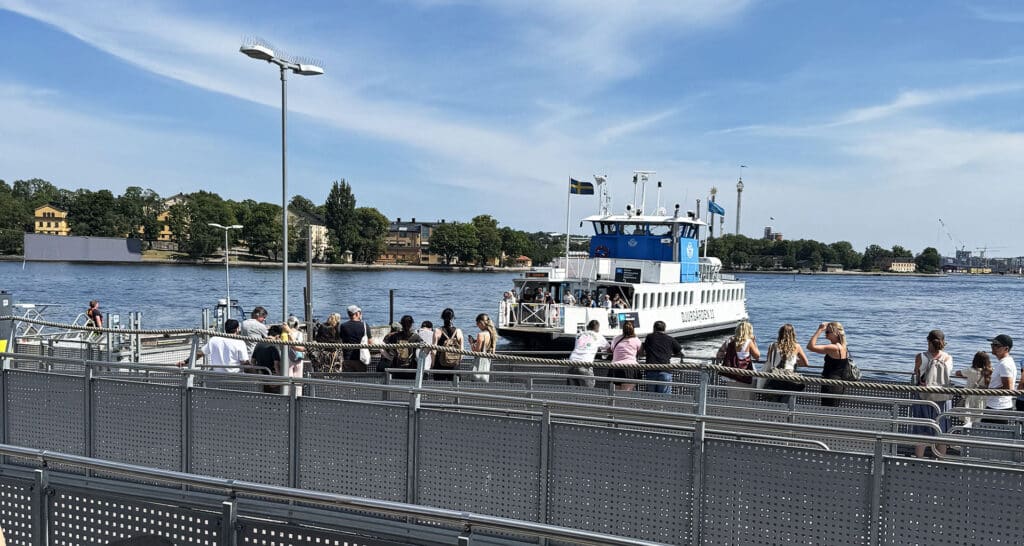
The ferry docked, close up on the hull and bow.
The journey to the Stockholm Vasa Museum started with a walk through Gamla Stan's narrow streets down to Slussen. Ferry Line 82 boards just a few minutes from the Royal Palace. From there the boat runs to Skeppsholmen, then on to Allmänna gränd on Djurgården. That stop sits nearest to Gröna Lund, ABBA The Museum, and Vasa. A direct crossing takes about ten minutes, though with the Skeppsholmen stop and any wait at the dock, the full loop runs closer to twenty.
As the ferry closed in on Djurgården, Gröna Lund's amusement park rides also came into view. Twin drop towers rose above the trees, one crowned with a golden sun and the other with a gilded orb. Behind them, a purple roller coaster looped through the branches.

Gröna Lund's towers rising above Djurgården, first glimpse from the ferry.
Djurgårdsfärjan runs four vessels on rotation, numbered eight through eleven. Mine that day was Djurgården 11, a ferry that has worked this same crossing for years. She pulled up a few minutes later, and passengers along the rail waited as the boat swung in against the dock. A small crowd had already gathered by the barriers, phones out, waiting for the same crossing.
From the dock, a short walk led up toward the tram line. The Nordic Museum's spires rose behind the trees, and a sign pointed back toward the ferries.

A tram passing near the Nordic Museum, with a sign pointing back to the ferries.
ABBA, By Way of a Purple Carpet

Purple carpet queue at the ABBA Museum entrance.
A short walk from the dock brought me to ABBA The Museum. Its purple carpet then led a queue of visitors under the entrance sign. I skipped the ticket line and never went inside, so this stop stayed a walk by rather than a full visit. Outside, a life size photo cutout still let me step into the band's iconic pose, silver jumpsuits, platform boots and all.

ABBA photo cutout board, faces cut out for visitors.
The museum opened its doors in May 2013, right here on Djurgården next to Skansen and the Nordic Museum, drawing inspiration from the Beatles Story museum in Liverpool. The band still ranks among Sweden's best selling music exports of all time. All four members met, wrote, and recorded right here in Stockholm. Inside, visitors get interactive exhibits instead of static glass cases, and one room even lets fans sing alongside holographic versions of the group.

Archer statue on a column near the ABBA Museum.
Just around the corner, a bronze archer stood frozen mid throw atop a tall column. It marks the plaza near the museum with a striking bit of public art.
Bågskytten, The Archer

Close up of the archer statue mid draw.
The statue beside the tram tracks is Bågskytten, The Archer, by sculptor Carl Milles. He cast it in 1919, decades before Djurgården became a museum district. The bronze figure stands on a tall granite column outside Liljevalchs konsthall, the island's art gallery from 1916. Milles ranks among Sweden's most celebrated sculptors, and his work still turns up all over Stockholm. Inside the Nordic Museum nearby, his towering Gustav Vasa figure dominates the main hall. The Archer itself captures a single frozen moment, muscles straining, bow pulled back at full stretch. That coiled energy became something of a signature for Milles, so the archer greets everyone walking toward it and toward ABBA The Museum a few steps beyond.
A Stockholm Vasa Museum Detour for Aquavit

Tasting flight of four Swedish spirits with a cheese and crispbread pairing.
Next door to the Stockholm Vasa Museum sits the Spritmuseum, the Museum of Spirits. A nonprofit foundation called Stiftelsen Vin & Sprithistoriska Museet runs it today. That same foundation, dating back to 1992, also holds the state owned Absolut Art Collection. I stopped in for a tasting flight of four spirits, aquavit, spiced brännvin, båsk, and Swedish punsch. Each one came with its own card of history. One card covered the wormwood bitterness of båsk, and another covered the East India Company origins of punsch. A small board of cheese, crispbread, and a sprig of dill rounded out the tasting.
More on Absolut Vodka
Absolut Vodka traces back to 1879, when Lars Olsson Smith introduced his own clean distilled recipe. Sweden then nationalized the entire alcohol industry in 1917. That single move folded Absolut's production into the state monopoly Vin & Sprit, which still shares roots with the foundation that runs Spritmuseum today.
The modern Absolut brand relaunched in 1979 with a new look. Its designers based the bottle on an old medicine jar found in a Gamla Stan shop window. Meanwhile, the Absolut Art Collection on view inside Spritmuseum started in 1986, and it now holds close to 850 commissioned works. Andy Warhol was also among the first artists involved, and his contribution linked the brand's advertising to fine art from the very start.
Into the Stockholm Vasa Museum

Approaching the museum entrance, anchor and building facade in view.

Bronze 1942 shipyard relief map outside the museum.
From there, a short walk led to the Stockholm Vasa Museum. The museum stands on the old Galärvarvet naval shipyard. A bronze relief model outside shows the yard as it looked in 1942. Workers later cleared the site to make way for the museum in the late 1980s.
A Warship That Never Sailed

Vasa's bow towering over visitors inside the museum hall.
King Gustav II Adolf ordered Vasa built between 1626 and 1628, meant as the mightiest warship in the Baltic. Shipwrights added an extra gun deck partway through construction, and that late change threw off her balance. She set sail on her maiden voyage on August 10, 1628, and capsized less than a mile from the dock. Barely 30 minutes into the voyage, water poured through her open gun ports. She sank in full view of the crowd that had gathered to watch her leave. The ship then sat on the harbor floor for 333 years, largely forgotten. Stockholm's brackish water saved her in the end, since low salinity and cold temperatures kept away shipworm, the creature that usually destroys sunken wood within decades.
The Vasa's bow rises several stories inside the museum hall.
Anders Franzén located the wreck in 1956, and divers spent years preparing her for salvage. She rose to the surface again in 1961, remarkably whole for a ship that old. Conservators then spent decades treating the timber with a wax like preservative to keep it from cracking as it dried. Today she stands as one of the best preserved 17th century ships anywhere in the world. That history explains why the hull feels less like an exhibit and more like a ghost holding her shape.
Nothing quite prepares you for walking into that dark concrete hall and seeing the actual ship. She carries 64 guns and stands nearly 400 years old, salvaged almost entirely intact from the bottom of Stockholm harbor. The scale feels disorienting, and her bow alone towers several stories overhead.

Scale model of Vasa fully rigged and sailed.
A fully rigged scale model nearby shows what she would have looked like under sail. The wreck itself, stripped of its masts, can't convey that on its own. Alongside it, a preserved bronze cannon from the wreck sits under glass, standing as a reminder of exactly what this ship was built for.

Original bronze cannon recovered from the wreck.
The real showstopper, though, is the carving. Hundreds of wooden figures, soldiers, warriors, faces, mythological creatures, once covered the ship's stern. They arrived dark and weathered, just as recovered from the sea. A separate case nearby displays some of these same figures repainted in their original colors. Gold crowns, red robes, and gilded lions bring a jolt of color to the display. That color makes clear just how ornate and boastful this warship was meant to look.

Weathered wooden carvings from the ship's stern.

The same figures shown repainted in their original vivid colors.
The whole stop ran about ninety minutes. That total included a twenty minute film covering the ship's history before the exhibits took over. The film ran in a small theater inside the hall, and it fit naturally into the visit rather than pulling me away from the ship itself.
Back Across the Water

The tall ship af Chapman, moored near Skeppsholmen.
Leaving Vasa, I retraced the route back toward the ferry. The old steamship Sankt Erik, black hulled with a white superstructure, sat moored along the quay. A marina full of yachts and sailboats followed next, backed by Gamla Stan's copper green rooftops and spires.

Yachts on the water, Stockholm's domed skyline behind.
Finally, the tall three masted af Chapman came into view, sails furled, anchored near Skeppsholmen.
A last look at the Line 82 route map at the dock closed the loop on the day. Gamla Stan, Skeppsholmen, and Djurgården, all the stops of the afternoon, sat laid out in one glance.

Ferry Line 82 route map at the dock.
Know Before You Go: Vasa Museum
- Ticket Booking: Buy time-slotted tickets online in advance during peak summer months (June-August) to skip the main entry queue. Children under 18 enter free.
- Ideal Visit Times: Arrive right at opening or after 3:00 PM. Midday (11:00 AM-2:00 PM) sees heavy tour group crowds around the primary ground-floor viewing platforms.
- Climate Control & Clothing: The hall is kept at a constant 64°F-68°F (18°C-20°C) and 55% humidity to preserve the 17th-century oak timber. Bring a light jacket or sweater, even in mid-summer.
- Transit & Arrival: Take the Djurgården Ferry (Line 82) from Slussen/Gamla Stan directly to Allmänna Gränd for scenic harbor approach views, or hop on Tram 7 from T-Centralen straight to the Nordiska museet/Vasamuseet stop. Standard SL transit passes cover both.
Related Stories
Explore and Discover



The Travel Tipster
I'm Ed Vasquez — The Travel Tipster. I've explored 35 countries and 100+ cities, almost always in a business class seat earned entirely through points. Firsthand destination guides, honest reviews, and practical points advice — from someone who has actually been there.