
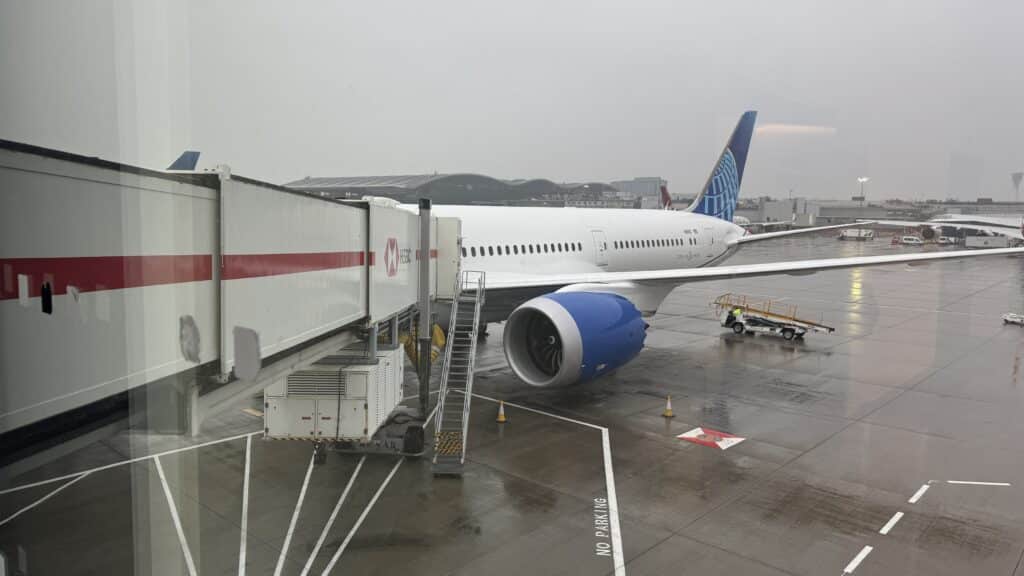
United 787 Elevated Polaris Review: Sacrificing Comfort & Space
United 787 Elevated Polaris vs. Classic Polaris: What Changed
I flew United 787 Elevated Polaris from San Francisco to London Heathrow on UA 930, seated in 7D in the forward cabin. After my experience, Air France still remains the winner. Stepping onto a two-week old factory-fresh interior brings high expectations.
United Airlines has deployed its "Elevated" 787-9 interior on select flagship routes out of San Francisco to London Heathrow, Singapore, Zurich, and Seoul Incheon. The overhauled cabin features sliding privacy doors, 4K OLED touchscreens, and a fundamental reconfiguration of passenger deck space, which is great for United revenue but not so much for passengers and flight crew. In fact, when you fly Business Class for comfort, this new interior fails BIG TIME.
Behind the modern aesthetic lies a clear commercial objective: premium cabin density. United replaced 65 standard economy seats with 16 additional Polaris business class suites and 14 Premium Plus recliners. While total passenger capacity drops from 257 down to 222 seats, the front of the aircraft swells to an unprecedented 64 Polaris suites (including 8 larger "Polaris Studio" suites) plus 35 Premium Plus recliners—putting 99 premium passengers on a single twin-aisle jet.
To fit that many lie-flat suites into an 18-foot fuselage, United selected the Ascent platform from Elevate Aircraft Seating (formerly Adient Aerospace), customized with privacy doors. The trade-off is clear: by packing 99 premium passengers into the forward two-thirds of the aircraft, personal floor storage and galley service pacing face noticeable constraints.
The Elevated Polaris Engineering Behind Two Distinct Cabin Geometries
The interior cabin width of a Boeing 787 Dreamliner is 18 feet 0 inches (5.49 m)—a full 15 inches narrower than the 19-foot-3-inch cabin of a Boeing 777. While original Polaris cabins (designed with Acumen and PriestmanGoode, built by Zodiac Seats UK, now Safran) relied on alternating straight and angled pods, the Elevate Ascent layout on this United Elevated 787 Polaris splits the business section into two distinct operational zones across 16 rows:
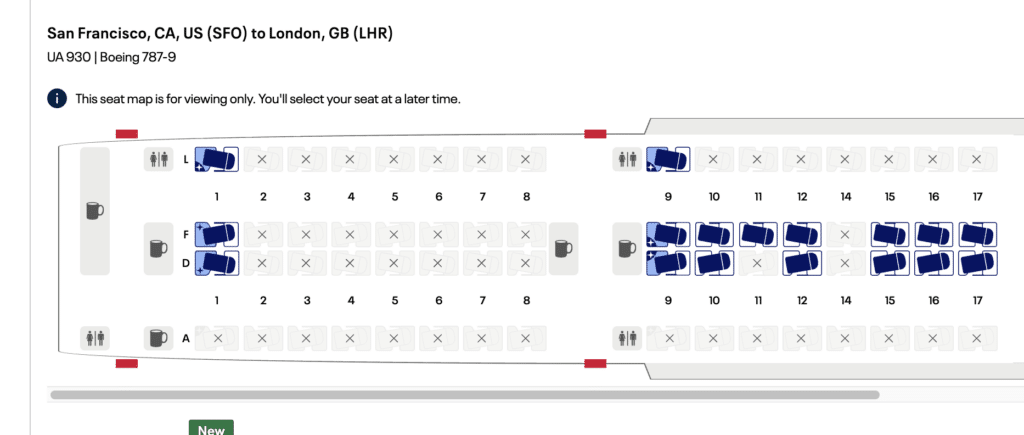
- Forward Cabin (Rows 1–8): Arranged in a reverse-herringbone configuration. Window seats face outward toward the windows, while the center D and F suites angle inward toward the center line.
- Aft Cabin (Rows 9–17): Configured in a standard herringbone pattern where center suites angle outward toward the aisles. The seat map numbers through Row 17 because Row 13 is skipped, maintaining 16 total rows of business class.
- The 8 "Polaris Studio" Bulkheads: Not all 64 suites are identical. Row 1 and Row 9 (bulkhead positions 1A, 1D, 1F, 1L and 9A, 9D, 9F, 9L) feature expanded "Polaris Studio" suites that are roughly 25% larger than standard Polaris suites, with a companion ottoman seat and a 27-inch 4K OLED screen. Most Studios reportedly include a buddy seatbelt for the companion seat, though center positions 1D and 1F reportedly do not. The remaining 56 standard suites absorb the bulk of the spatial tightening.
Cabin Dimensions & Layout Comparison
| Aircraft Type | Interior Cabin Width (Boeing Specs) | Polaris Suite Count | Seat Configuration Style | Observed Living Space & Storage Profile |
|---|---|---|---|---|
| Boeing 777-200ER / 300ER | 19 ft 3 in (231 in) | 50–60 suites | Alternating 1-2-1 (Straight & Angled) | Wide-aperture cubby, open side console counter, wider aisles |
| Boeing 767-300ER "High-J" | 15 ft 6 in (186 in) | 46 suites | 1-1-1 Staggered | Deep rectangular footwell, quiet single-passenger privacy |
| Boeing 787-9 Classic | 18 ft 0 in (216 in) | 48 suites | Alternating 1-2-1 (Straight & Angled) | Flat floor-level shoe stowage beneath the ottoman |
| Boeing 787-9 "Elevated" (Ship 1113) | 18 ft 0 in (216 in) | 64 suites (8 Studio / 56 Standard) | Split Herringbone: Inward (Rows 1–8) / Outward (Rows 9–17) | Tapered wedge footwell, elevated internal ramp, split console |
Where Did the Personal Space Go on the New United 787 Elevated Polaris Suite?
In standard seat 7D in the forward cabin, the inward chevron geometry makes the reduction in personal volume immediately apparent.

The tapered footwell in seat 7D, with the raised foot ramp that replaces under-ottoman shoe storage.

The side console is split by seat hardware, leaving a nook about the size of a folded face mask.
1. The Wedge Footwell and Elevated Ramp
Unlike classic Polaris suites that allow passengers to slide shoes directly under the ottoman, this installation incorporates an elevated foot ramp. This structural rise consumes the lower floor cavity, removing the under-seat space previously used for footwear or small day packs.
Furthermore, because forward center seats angle inward toward the centerline, the footwell tapers sharply into a wedge. In seat 7D, when resting flat, my feet ended up positioned tightly side-by-side, with what I estimated at only 3 to 4 inches of lateral foot clearance. Sleeping on your side or shifting from side to back requires conscious repositioning.
2. The Truncated Storage Nook
The side console shelf has also been substantially redesigned. Rather than an open surface capable of holding a tablet, large smartphone, or amenity kit, the compartment is split by internal seat mechanisms:
- The forward section is sealed off by hardware components.
- In seat 7D, the remaining open storage nook was roughly the width and depth of a folded protective face mask, limiting stowage to small essentials like a passport or charging cable.

The literature pocket is narrow, with room for little more than a safety card and a slim laptop or tablet even though the pocket says to put nothing there.

Dual USB-C ports and a wireless charging pad, both easy to reach from the seat.

Wireless phone charging pad.
On the technology side, connectivity on this United 787 Elevated Polaris is well executed: dual high-output USB-C ports sit accessible without contorting around the seat controls, accompanied by an integrated wireless Qi charging pad that keeps smartphones securely in place during turbulence.
Ergonomics & Sleep

Saks Fifth Avenue bedding, delivered rolled and wrapped, with no flat surface to set it on during dinner.
Seat Cushioning
Roughly 90 minutes into the flight, the seat bottom cushion felt noticeably firm under the thighs and lower back. Commercial aircraft seats use certified flame-retardant open-cell polyurethane foam designed to meet strict FAA burn and impact criteria. On an airframe that only recently left the factory floor, this foam has not yet experienced the natural compression and break-in cycle of older cabins, resulting in a noticeably stiff ride.
Leg Rest Extension
In intermediate cradle recline, the calf support flap feels noticeably short. Rather than extending forward to cradle the lower calf and Achilles tendon, the motorized leg rest stops near my knee crease. I am 5' 10" tall. For an average-height traveler, this leaves the lower legs and feet dangling without direct support, making the intermediate recline position awkward for prolonged lounging.
Staging the Bedding
United continues to supply Saks Fifth Avenue duvets and pillows. However, because the wide side console ledge of older Polaris layouts has been replaced by smaller angular surfaces, there is no flat staging area to set the bedding during meal service. Unless you choose to keep both pillows on your lap, the only open spot is the floor carpet.
Mechanical & Systems Performance
- Shoulder Harness Retraction: On angled business class suites, safety regulations mandate a three-point shoulder harness during taxi, takeoff, and landing. After take-off, when it was OK to remove the shoulder belt, the shoulder belt mechanism jammed in the extended position after unbuckling, refusing to retract until firmly pulled during descent preparations.
- In-Flight Wi-Fi Dropout:

The Wi-Fi portal showing “Network: Unavailable” at 8:20 PM, about half hour after departure.
At 8:20 PM—shortly after departure on our evening flight scheduled for 7:45 PM—the onboard Wi-Fi connection still showed "Network: Unavailable" across the portal. The landing page confirmed the connection was operating on United's Panasonic network rather than the airline's ongoing fleet-wide Starlink rollout. While United is actively expanding Starlink access across mainline aircraft, this specific delivery operated on Panasonic satellite architecture, and connection dropouts remain an in-flight frustration.
In-Flight Entertainment & Privacy Doors

The 19-inch 4K OLED screen showing the flight map: sharp, bright and responsive.

The manual sliding door closes off the suite from aisle traffic.
- Panasonic Astrova 4K Display: The 19-inch 4K OLED touchscreen is bright and responsive. The interface displays route details, interactive flight maps, and movie options with excellent clarity and contrast, though United has omitted external landscape cameras.
- Manual Sliding Privacy Doors: The manual latching sliding door works smoothly. Once pulled shut, it creates a clean sightline block from aisle traffic, delivering a private suite environment.
Dining & Cabin Service Dynamics

The prawn and cucumber-bread salad starter, the highlight of dinner service.
- Flight Attendant Team (Grade: A+): The cabin crew delivered warm, professional, and attentive service while managing a full cabin under demanding operational conditions.
- Galley Service Pacing: Dinner service concluded slightly past the two-hour mark. In my view, catering 64 Polaris and 35 Premium Plus passengers (99 premium meals) out of compact modern Dreamliner galley footprints creates clear workflow bottlenecks. On previous long-haul flights with smaller business cabins, tray clearance was noticeably faster - usually finishing in 75-minutes or so. This preserved more uninterrupted rest time on a 10-hour transatlantic segment. But now, if flying this aircraft, eat at the Polaris lounge and forego dinner service if sleep is what you want.
- Catering: The chilled prawn and cucumber-bread salad appetizer was fresh and well-balanced. The pasta main course was somewhat dry and not worth the two-hour wait. Dessert service featured pre-plated sundaes assembled directly on galley trays rather than the traditional cart service.
Fleet Context & Deployment
United plans to have at least 30 Boeing 787-9 aircraft featuring the Elevated interior flying globally by the end of 2027. Deployment focuses on key long-haul business markets:
- Established Transpacific & Transatlantic Routes: San Francisco (SFO) to London Heathrow (LHR), Singapore (SIN), Zurich (ZRH), and Seoul Incheon (ICN).
- Houston (IAH) Long-Haul Expansion: Announced deployments from Houston to São Paulo (GRU), Sydney (SYD), and Tokyo Narita (NRT) in late 2026, followed by London Heathrow (LHR) in early 2027.
Passenger Strategies for the 64-Seat United 787 Elevated Polaris
- Dine in the Polaris Lounge: Prior to evening departures, take full advantage of the sit-down dining at the Polaris Lounge. This allows you to skip the two-hour onboard meal service and recline immediately for sleep after takeoff.
- Rely on Lie-Flat Rather Than Cradle Mode: Because the leg rest extension stops short of supporting the calves, bypass the intermediate cradle recline. Go fully flat to 180 degrees, using the Saks pillow beneath your knees to relieve lower-back pressure.
- Download Content Offline: To avoid disruptions if satellite connectivity drops, download critical reading materials, work documents, and video entertainment directly to your mobile devices prior to boarding.
- Stow Bedding in the Overhead Bin at Boarding: To keep your seat and floor space clear during departure and dinner, place your Saks duvet and secondary pillow in the overhead bin until you are ready to sleep.
- Choose Aircraft Based on Travel Priorities: If maximizing sleeping room is your primary objective, booking a Boeing 777-200ER/300ER provides an open, non-angled footwell. For solo travelers, the Boeing 767-300ER "High-J" offers dedicated 1-1-1 window seats with no shared center divider.
The Verdict on the United Elevated 787-9
United’s 64-seat Boeing 787-9 represents a powerful commercial optimization, successfully expanding premium seating capacity while introducing crisp 4K OLED displays and sliding privacy doors. However, that density comes with real compromises: standard suites feature tighter wedge footwells, reduced side console storage, and longer meal service times resulting from high passenger-to-galley ratios. For travelers seeking maximum sleeping space and personal volume, United's wider classic widebodies remain the more forgiving ride.
Explore and Discover










The Travel Tipster
I'm Ed Vasquez — The Travel Tipster. I've explored 35 countries and 100+ cities, almost always in a business class seat earned entirely through points. Firsthand destination guides, honest reviews, and practical points advice — from someone who has actually been there.